
Ask any sheet metal contractor what’s keeping them up at night and you’ll hear the same short list: not enough skilled hands, schedules that keep compressing, and customers who expect more of the work to arrive on site ready to hang.
None of those pressures are new. What’s changed is how much they now shape who wins work. In a 2025 Dodge Construction Network survey of 197 U.S. mechanical contractors performing sheet metal, piping and plumbing work, 82% said owners and GCs now require fabrication capability when selecting a mechanical contractor. Prefabrication has moved from a differentiator to a qualifier.
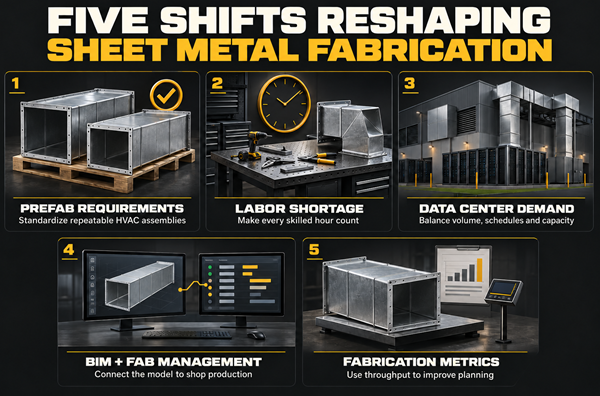
Here are five shifts reshaping sheet metal fabrication this year, and practical steps shops of any size can take.
1. Why is prefabrication becoming a requirement for HVAC contractors?
Short answer: Owners and GCs want predictable schedules and fewer workers on crowded sites, and shop-built assemblies deliver both.
Sheet metal is already one of the most-fabricated trades. Dodge found that roughly 70% of mechanical contractors fabricate sheet metal, nearly level with piping (71%) and plumbing (66%). About three-quarters also combine multiple trades into single assemblies, and most of those report time savings.
The gap is in frequency. Large contractors fabricate across the three trades at an average rate of 87%, versus 70% for mid-sized firms and 56% for small ones. For smaller shops, that’s both the risk and the opportunity: the work is moving toward prefab regardless, so the question is whether you capture it or sub it out.
What to do now: Identify the two or three assemblies you build repeatedly, duct risers, equipment connections, hanger packages, and standardize them. Repeatable kits are the fastest path to prefab volume without new floor space.
2. How is the labor shortage changing the sheet metal shop?
Short answer: The shop is becoming a recruiting and retention tool, not just a production space.
A controlled shop environment attracts people the jobsite often loses: experienced journeymen who no longer want to travel, and younger workers who learn faster with digital tools. In the Dodge SmartMarket Brief, Ivey Mechanical described moving veteran road crews into its fab shop when travel became hard on their health, keeping decades of know-how in the company. The same firm noted that younger installers pick up model-based, piece-numbered assemblies quickly in the field.
More than half of Dodge respondents expect to add staff in BIM and fabrication over the next two years. Industry efforts like SMACNA’s Ignite Your Career campaign are building the pipeline, but hiring alone won’t close the gap, so the leverage is in making each skilled hour count.
What to do now: Track where skilled labor actually goes. If your best fabricators spend hours hunting for drawings, re-keying cut lists or chasing material, that’s capacity you already own but aren’t using.
3. What does data center construction mean for sheet metal contractors?
Short answer: Big opportunity, real exposure, and heavy pressure on schedules.
Data centers demand massive volumes of ductwork, containment and air-handling infrastructure, often on accelerated timelines. In a March 2026 ACHR News interview, FMI’s research lead reported that skilled labor is the top delivery challenge on large data center projects, that some contractors now draw more than half their backlog from the sector, and that prefabricated and modular components are the main way teams are meeting those schedules. He also noted some firms are deliberately capping data center exposure to stay balanced.
What to do now: Before chasing a hyperscale bid, stress-test shop capacity. Can you produce at data-center volumes while protecting your core commercial and institutional customers? Knowing your real throughput by weight and labor hour makes that call far less of a gamble.
4. Is BIM enough, or do sheet metal shops need fabrication management software?
Short answer: BIM tells you what to build. Fabrication shop management software tells you what’s actually getting built, when, and at what cost.
BIM software is nearly universal now: over 90% of Dodge respondents use it for fabrication, mainly to produce shop drawings and extract quantities. But the model is only half the workflow. About three-quarters of large contractors ($100M+) use fabrication shop management software, while smaller firms average about half.
Integration is where the payoff lives. Dodge found 86% have connected their BIM and fabrication management tools, yet only about half say those connections work seamlessly. Common breakdown points in sheet metal shops include:
- Manually re-entering fitting and spool data from CADmep/MAJ files
- Shop status living on whiteboards and spreadsheets the field can’t see
- No link between what was estimated and what the shop actually spent
What to do now: Map one job from model to delivery and count every manual handoff. Each one is a place where errors creep in and hours disappear.
5. How are sheet metal contractors using fabrication data?
Short answer: The leaders use shop data to bid, schedule and staff smarter, not just to report on the past.
Dodge found large contractors share fabrication data internally (for material management, scheduling and time tracking) at a 57% rate versus 42% at smaller firms. About three-quarters of all respondents share fabrication data externally with GCs, owners or other trades. And roughly half are already applying AI to fabrication work such as design optimization, estimating and error reduction.
For a sheet metal shop, the most useful starting metrics are simple: pounds fabricated per labor hour, average time per fitting type, and actual-versus-estimated hours per package. A few months of clean data turns bidding from educated guessing into evidence. Portland-area HVAC contractor Streimer, for example, replaced disconnected spreadsheets with connected shop data to improve labor planning and delivery coordination.
What to do now: Pick one metric, capture it consistently for 90 days, and compare it against your estimates on your next bid.
The bottom line for SMACNA contractors
Sheet metal fabrication is being shaped by forces no single shop controls: labor demographics, data center demand and customer expectations for prefab. What each shop does control is how well its people, its model and its floor are connected.
You don’t need to overhaul everything at once. Standardize repeatable assemblies, eliminate manual handoffs between the model and the shop, and start measuring throughput. Contractors who take those steps in 2026 will be the ones GCs call first in 2027.
FAQ
What percentage of mechanical contractors fabricate sheet metal? About 70%, according to Dodge Construction Network’s 2025 survey of 197 U.S. mechanical contractors.
Do GCs require prefabrication from HVAC subcontractors? Increasingly, yes. 82% of contractors surveyed by Dodge said owners and GCs require fabrication capability when selecting a mechanical contractor.
What is fabrication shop management software? Software that tracks fabrication work from the BIM model through cutting, assembly, QA and shipping, giving shop managers real-time status, labor and material data in place of spreadsheets and whiteboards.
What’s the best productivity metric for a sheet metal shop? Pounds fabricated per labor hour is a practical starting point because it ties material output directly to labor input and can be compared against estimates.
MSUITE, part of DEWALT Construction Technology, helps mechanical and sheet metal contractors connect BIM, fabrication and field data. Learn how sheet metal shops use MSUITE →
Sources:
- Dodge Construction Network, Optimizing Digital Fabrication for Mechanical Contractors SmartMarket Brief (survey of 197 U.S. mechanical contractors, August 2025) — download via MSUITE
- ACHR News, “How Data Center Growth Is Impacting Material, Labor, Competition” (Q&A with FMI, March 26, 2026)
- ACHR News, “SMACNA Launches National Ignite Your Career Workforce Development Campaign”