

How Prefabrication Construction Technology Reduces RFIs and Change Orders on MEP Projects. Every RFI costs something. Somebody has to write it, somebody has to answer it and a crew often waits in between. Multiply that across a project and the numbers get big fast.
A Navigant Construction Forum study of 1,362 projects found an average of nearly 800 RFIs per project, at roughly $1,080 each to review and respond to. That’s more than $850,000 per project before a single change order is priced. Mid-size jobs are hit hardest: projects between $5 million and $50 million averaged 17.2 RFIs per $1 million of construction cost.
MEP fabrication changes that math. When you build assemblies in a shop from a coordinated model, most of the questions that turn into field RFIs get answered on screen first. Here’s how it works and how to get the most out of it.
Definition: RFIs (Request for Information) and change orders in MEP construction. A RFI is a formal question from a contractor to the design team when drawings or specs are unclear, conflicting or incomplete. A change order is a written amendment to the contract that changes scope, cost or schedule. In MEP construction, many change orders start as RFIs. A field crew finds a clash or a missing dimension, asks the question and the answer adds work.
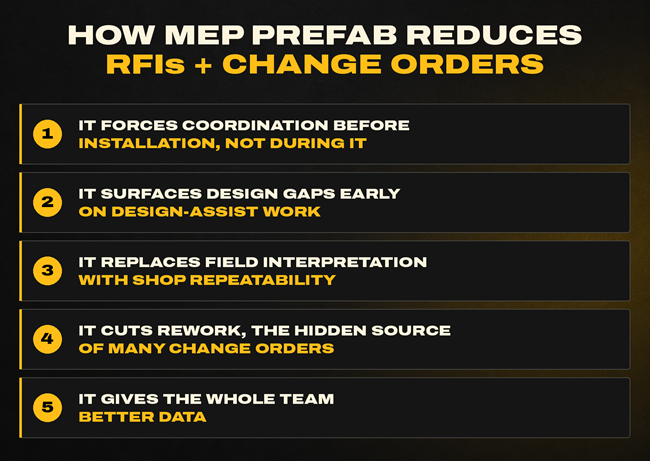
How does MEP prefabrication reduce RFIs and change orders on construction projects?
1. It forces coordination before installation, not during it
You can’t fabricate a spool from a vague drawing. Prefab requires fabrication-level detail: exact lengths, fittings, hanger locations and connection points. That pushes clash detection and design questions into the modeling phase, where they’re cheap to fix.
Ivey Mechanical shared a clear example in the Dodge Construction Network Optimizing Digital Fabrication for Mechanical Contractors SmartMarket Brief. While modeling a hospital project, their team discovered the mechanical space was 2 feet short for the selected air handling units. Because it was caught before the building was built, the owner was able to excavate and redesign the structure. Found in the field, that would have been a major change order.
2. It surfaces design gaps early on design-assist work
Contract drawings often leave out what MEP trades need to build. As Ivey’s BIM manager put it, design documents frequently “don’t show the insulation on all the different systems [or] show the hangers. All [those elements] take up space.” A fabrication model has to account for them, which is where automated hanger layout helps. Ivey also noted they see “more design issues on plan and spec jobs than we do on design-assist ones” and have helped engineers identify problems before construction.
3. It replaces field interpretation with shop repeatability
Field RFIs often come from crews interpreting the same detail different ways. In the shop, work is built to templates and mock-ups. Ivey’s example: give a complex clinical sink rough-in to 10 plumbers on site and “all 10 will be different. If we fabricate them in the shop, they are all going to be the same.”
4. It cuts rework, the hidden source of many change orders
Rework drives cost growth on both sides of the contract. Navigant’s rework study of 32 buildings found direct rework averaged about 5% of the original contract, with total impact around 10% once indirect costs are included. Design errors and omissions were the single largest cause. And the FMI and Autodesk Construction Disconnected study tied 48% of U.S. construction rework to poor data and miscommunication. Prefab built from a coordinated, version-controlled model attacks both causes.
5. It gives the whole team better data
About three-quarters of mechanical contractors in the Dodge research share fabrication data with GCs, owners or other trades. When everyone works from the same model and spool status, fewer questions need a formal RFI to answer.
What is the relationship between BIM-to-FAB accuracy and RFI reduction?
Prefabrication only reduces RFIs if the BIM model, the shop drawings and what’s built all match. If they drift apart, prefab can create problems: a spool built to an old revision won’t fit, and now you have an RFI, rework and possibly a change order dispute.
The research shows there’s still room to improve. 86% of mechanical contractors integrate BIM with fabrication management, but only about half say those integrations work seamlessly or very well (Dodge). The contractors who get it right report improved cost, schedule and quality performance, and reduced errors and waste from BIM-driven fabrication.
To protect BIM-to-FAB accuracy:
- Push spool drawings and cut lists directly from the model to the shop (see how BIM data reaches the shop). No re-keying.
- Control revisions on the floor. Fabricators should only see the current version, on a tablet or kiosk.
- Hold fabrication release until coordination sign-off for each area or package.
- Track every spool through QA/QC so you can prove what was built and when.
- Log design changes against packages. If a change hits work already fabricated, you have the timestamps and records to support a change order.
That last point matters. MCAA’s Change Orders, Productivity, Overtime primer covers BIM-related impacts and how to document them. Good construction technology software used for prefabrication gives you the records you need to manage price changes fairly.
ROI Callouts: What the industry research shows
| Metric | Source |
| ~800 RFIs per project at ~$1,080 each | Navigant Construction Forum (1,362 projects, via ASCC) |
| 17.2 RFIs per $1M on 50M projects | Navigant Construction Forum |
| ~10% of contract value: total cost of rework | Navigant Construction Forum (32 buildings) |
| 48% of U.S. rework caused by poor data and miscommunication | FMI / Autodesk Construction Disconnected |
| ~90% of prefab users report improved schedule certainty and quality | Dodge Prefabrication and Modular Construction 2020 |
| 80%+ report improved cost predictability | Dodge Prefabrication and Modular Construction 2020 |
| 82% say owners/GCs require fabrication capability | Dodge SmartMarket Brief (2025) |
RFIs and change orders aren’t just paperwork.
They’re time, labor and margin. Prefabrication cuts them by moving questions upstream into the model and building work in a controlled, repeatable environment. According to Dodge’s 2020 prefab research, about 90% of users report better schedule certainty and quality. But the gains depend on accuracy from BIM to fab to field. Connect the model to the shop, control revisions and track every spool, and prefab becomes one of the most reliable ways to protect your margin in MEP construction.
FAQ – People Also Ask
How does prefabrication reduce RFIs in MEP construction? Prefab requires fabrication-level detail, so clashes, missing dimensions and design gaps are resolved in the model before installation. That replaces many field-generated RFIs with earlier, cheaper coordination.
How much does an RFI cost on a construction project? A Navigant Construction Forum study of 1,362 projects estimated about $1,080 per RFI in review and response cost, with nearly 800 RFIs on an average project.
Can prefabrication increase change orders? It can if design changes hit work already fabricated or if the shop builds from an outdated revision. Revision control, coordination sign-off before release and spool-level tracking reduce that risk and document legitimate changes.
What is the relationship between BIM accuracy and RFIs? The more accurately the coordinated model flows to shop drawings and fabrication, the fewer field conflicts arise. Dodge found 86% of mechanical contractors integrate BIM with fabrication management, but only about half say it works seamlessly.
What software helps reduce RFIs on MEP projects? BIM coordination tools combined with fabrication management (prefab) software that pushes model data to the shop, controls revisions on the floor and tracks each spool through QA/QC and delivery.

DEWALT Construction Technology connects BIM, fabrication and field so the spool built in the shop matches the model that was coordinated. See BIM-to-FAB-to-Field in action: book a demo →
Related reading on msuite.com:
- Accelerating Pipe Spool Production with MSUITE BIM in Revit
- How BIM Improves Pipe Spool Fabrication and Shop Production
- BIM Automation for Support System Layout
- How MSUITE Hangers Solve the Placement Problem
- BIM-Driven Spooling Streamlines the Fabrication Process
Sources:
- Navigant Construction Forum, Impact & Control of RFIs on Construction Projects (2016) and The Impact of Rework on Construction & Some Practical Remedies (2012), summarized by ASCC, “Request for Information (RFI) and Rework” (2020)
- Dodge Construction Network, Optimizing Digital Fabrication for Mechanical Contractors SmartMarket Brief (survey of 197 U.S. mechanical contractors, August 2025), download via MSUITE
- Dodge Data & Analytics, Prefabrication and Modular Construction 2020 SmartMarket Report
- FMI and Autodesk, Construction Disconnected (2018)
- MCAA, Change Orders, Productivity, Overtime: A Primer for the Construction Industry