
Mechanical contractors are using prefabrication to move into industrial construction by delivering what industrial owners and EPC firms care about most: traceable, spec-compliant pipe spools and assemblies, on schedule, with less labor on site. The contractors winning this work run their fab shop as a production facility connected to the model and the field, not as a side operation.
That matters now because construction growth in 2026 is concentrated in a few sectors, and most of them are industrial.
What is industrial prefabrication?
Industrial prefabrication is the off-site fabrication of piping, mechanical, electrical and structural assemblies for power plants, data centers, energy facilities and process projects. Components are built in a controlled shop from fabrication-ready models, then shipped with documentation such as weld logs, heat numbers and inspection records so they can be installed and turned over to the owner.
Where the industrial growth is in 2026
Commercial work is flat in most markets. The money is moving toward power, energy and mission-critical facilities.
- Deloitte’s 2026 Engineering and Construction Industry Outlook projects investment in structures to grow roughly 1.8% in 2026, led by AI-related data center and energy projects.
- FMI’s Q3 2026 North American Engineering and Construction Outlook forecasts data center construction up 21.4% to $60 billion this year, with power spending on track to reach $274 billion by 2030.
- ConstructConnect’s October 2026 Data Center Report counted $98.5 billion in data center starts through August across 153 projects, with new builds shifting toward the Midwest and South.
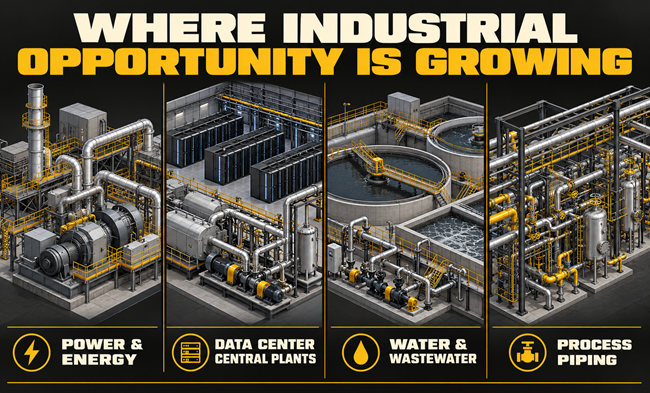
There is a caution in the same data. FMI expects manufacturing construction to fall 17.4% to $178 billion this year as the large factory projects of the past few years finish their heavy-spending phases. “Industrial” is not one market. Power generation, data center central plants, water treatment and process piping are where backlog is building. Contractors still chasing factory megaprojects may be pursuing the one industrial segment that is shrinking.
Why prefabrication is the entry ticket
Owners and EPC firms already expect it. In a Dodge Construction Network study released in February 2026 with DEWALT, 82% of mechanical contractors said fabrication capability is now a prerequisite for winning projects.
Labor is the other driver. Associated Builders and Contractors estimates the industry needs 349,000 net new workers in 2026 and 456,000 in 2027, and most of this year’s demand comes from retirements rather than new work. Industrial sites are often remote, which makes staffing harder. Every weld moved from a pipe rack 40 feet in the air to a positioner in a heated shop is a weld you can staff, inspect and schedule with confidence.
Deloitte’s outlook makes a related point. As more construction shifts into factory settings, the workforce moves away from traditional craft roles toward shop technicians and digitally skilled operators. Contractors who already run a fabrication shop have a head start.
What industrial EPC projects demand that commercial work doesn’t
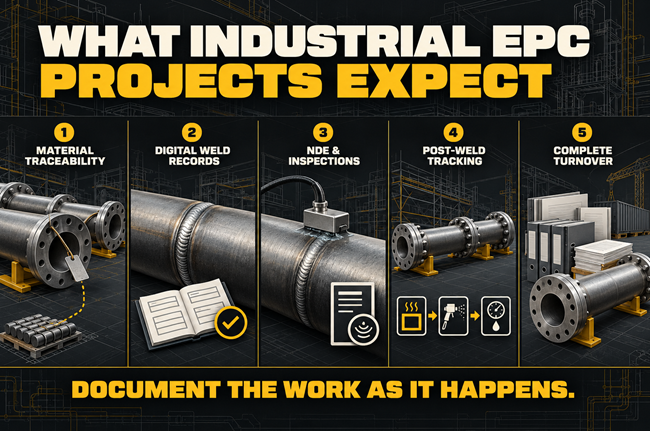
A commercial mechanical job and an industrial EPC package can use the same pipe and the same welders. The documentation is what separates them. Industrial owners typically require:
- Material traceability. Heat numbers tied to every spool, often down to the component.
- Weld records. Welder ID, weld procedure, joint number and inspection result for each weld.
- Nondestructive examination (NDE) tracking. Radiography, ultrasonic and other test results recorded against the joint.
- Post-weld processing. Routing through stress relief, coatings, paint or hydro testing, with status visible to the project team.
- Turnover packages. Complete records that ship with the work instead of being rebuilt at closeout.
Shops that try to manage this with spreadsheets and paper travelers find that the documentation load grows faster than the tonnage. That is usually the point where industrial work stops being profitable.
How are contractors using prefabrication to expand into industrial construction markets?
A shop moving into industrial work generally needs five capabilities in place before it bids:
- Fabrication-ready modeling. Spool drawings generated from the coordinated model, with version control so the shop never builds from a superseded ISO.
- Spec-driven workflows. Projects carry different codes and client specs. Workflows should change stages and required data by project instead of forcing every job through one generic routing.
- Digital weld and QA/QC records. Captured at the station as work happens, not entered later from memory.
- Real-time production status. The PM, engineer and shop manager see the same view of what is cut, welded, tested, coated and ready to ship.
- Shipping and receiving control. Bills of lading that carry drawings and weld logs with the load, plus a digital receiving step in the field.
MSUITE FAB for industrial fabricators is built around these requirements. Its weld log captures welder ID, procedures, heat numbers, inspector and QA results. It tracks NDE digitally and automatically routes post-weld processes such as X-ray, coatings and hydro testing.
BIM-to-FAB-to-Field: where margin is won or lost
Most mechanical contractors already own the tools. The Dodge study found 87% use BIM and more than 90% of BIM users apply it to fabrication. The weak point is the connection between systems. According to the same research, 86% of firms have built integrations between BIM and digital fabrication systems, but only 50% say those integrations work well.
On an industrial job, that gap looks like a revised ISO that never reached the welder, a spool that passed hydro but sat in the yard because the field didn’t know it was ready, or a turnover package assembled by hand in the last month of the project. Each one is a schedule hit the EPC will remember at the next bid.
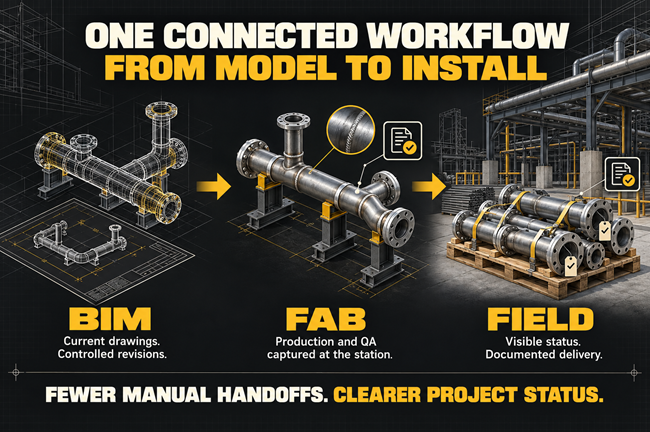
BIM-to-FAB-to-Field orchestration means the model, the shop and the jobsite work from one record. Design data flows into the shop without re-keying. Production and QA data are captured as work happens. The field sees status before the truck arrives.
A practical path into industrial work. What fabrication capabilities do Mechanical contractors need for industrial EPC projects?
For contractors planning a first industrial project, this sequence keeps risk manageable:
- Pick one industrial segment with backlog in your region, such as power, data center central plants or water.
- Win a scope you can fabricate and document completely, even if it is small.
- Standardize spec-driven workflows and weld documentation in the shop before the second job.
- Use production data from the first project to price the next one accurately.
- Lead prequalification with your traceability and turnover records, not just shop square footage.
Frequently asked questions
How are MEP contractors using prefabrication to expand into industrial construction markets?
They use their fabrication shops to deliver traceable pipe spools, skids and assemblies to power, data center, energy and process projects. Shop fabrication reduces on-site labor, improves weld quality and produces the documentation EPC firms require at turnover.
What fabrication capabilities do MEP contractors need for industrial EPC projects?
At minimum: fabrication-ready spool drawings with version control, spec-driven shop workflows, digital weld logs with heat number traceability, NDE and post-weld tracking, real-time production status, and documented shipping and receiving.
Is manufacturing construction still a good industrial target in 2026?
It depends on the region. FMI forecasts manufacturing construction down 17.4% this year as megaprojects wind down, while data centers and power keep growing. Many contractors are rebalancing their industrial pursuits toward those segments.
Do contractors need a separate shop for industrial work?
Not necessarily. Many run commercial and industrial work through the same facility and use project-specific workflows to apply stricter documentation only where the spec requires it.
See how MSUITE supports industrial fabrication. If you are bidding industrial or EPC packages, MSUITE FAB gives your shop the traceability, QA records and production visibility those owners expect. Schedule a demo to see it run on your own spool data.
Sources
- Deloitte, 2026 Engineering and Construction Industry Outlook
- Construction Executive, Heads or Tails: Deloitte’s 2026 Construction Industry Outlook
- FMI, 2026 North American Engineering and Construction Outlook: Third Quarter
- ConstructConnect, October 2026 Data Center Report
- Business Wire, DEWALT and Dodge Construction Network digital fabrication study (Feb. 2026)
- Dodge Construction Network, Optimizing Digital Fabrication for Mechanical Contractors SmartMarket Brief
- Construction Executive, Workforce Crunch Ahead (ABC 2026 workforce analysis)
- MSUITE FAB for Industrial Builders