
Fabrication management software helps MEP contractors win more bids in three ways. It pulls quantities straight from the model, so estimates and revised pricing go out faster. It grounds labor and material assumptions in how the shop actually performs, so bids carry less padding. And it gives general contractors visible proof that the shop can deliver on schedule, which is often what separates two bids at similar prices.
That proof now carries real weight in MEP fabrication. In the Dodge Construction Network and DEWALT SmartMarket Brief on digital fabrication, 82% of mechanical contractors said fabrication capability is required to win work. The contractors below used MSUITE to show GCs and owners exactly what that capability looks like.
What Is Fabrication Management Software?
Fabrication management software is a production platform that connects the BIM model, the shop floor, and field installation in one workflow, so drawings, quantities, and the status of every spool or assembly live in a single system from bid to delivery.
MSUITE, a cornerstone product of DEWALT Construction Technology, connects BIM, FAB, and FIELD for MEP and industrial fabrication, is built on that idea. MSUITE BIM runs inside Autodesk Revit to generate spools, sheets, and cut lists. MSUITE FAB tracks each piece through cutting, fit-up, welding, and shipping. MSUITE FAB in the field shows installers what is coming and when.
Why Do MEP Contractors Lose Bids They Should Win?
Price matters, but many lost bids trace back to process. Estimates go out late because someone is counting fittings off a PDF. Numbers carry extra contingency because no one is sure how long the shop really takes. And when the GC sits down to compare subs, nothing in the proposal shows why your shop is a safer choice than the next one.
Jackson & Blanc, a mid-sized mechanical contractor in Southern California, knew the first problem well. Before adopting MSUITE, Fabrication Shop Foreman Brian Underwood described a stream of emailed phone photos of isometric drawings, PDFs his team printed and marked up with cut lists by hand, and deadlines tracked in spreadsheets. “Every single step was manual,” he said.
How Can MEP Contractors Use BIM-to-FAB Automation to Produce Faster Estimates?
The speed gain comes from using one set of model data for detailing, takeoff, and production instead of recreating it at each step. A typical workflow in MSUITE’s MEP software looks like this:
- Model once in Revit. Pipe, duct, and fittings are drawn as fabrication parts, so quantities already exist in the model.
- Spool with rules. MSUITE BIM applies spool break logic, naming conventions, dimensions, and tags the same way on every system.
- Generate cut lists and bills of material automatically. Material counts come from the model, formatted to match how the shop pulls stock.
- Send to the shop. Spools and sheets move into MSUITE FAB, so production starts from the same data the estimate used.
At Jackson & Blanc, that shift removed hours of manual takeoff. “I don’t have to sit here with somebody else’s drawings and figure out the take-offs for their 90s in their flanges,” Underwood said. “BIM does all of that for me.”
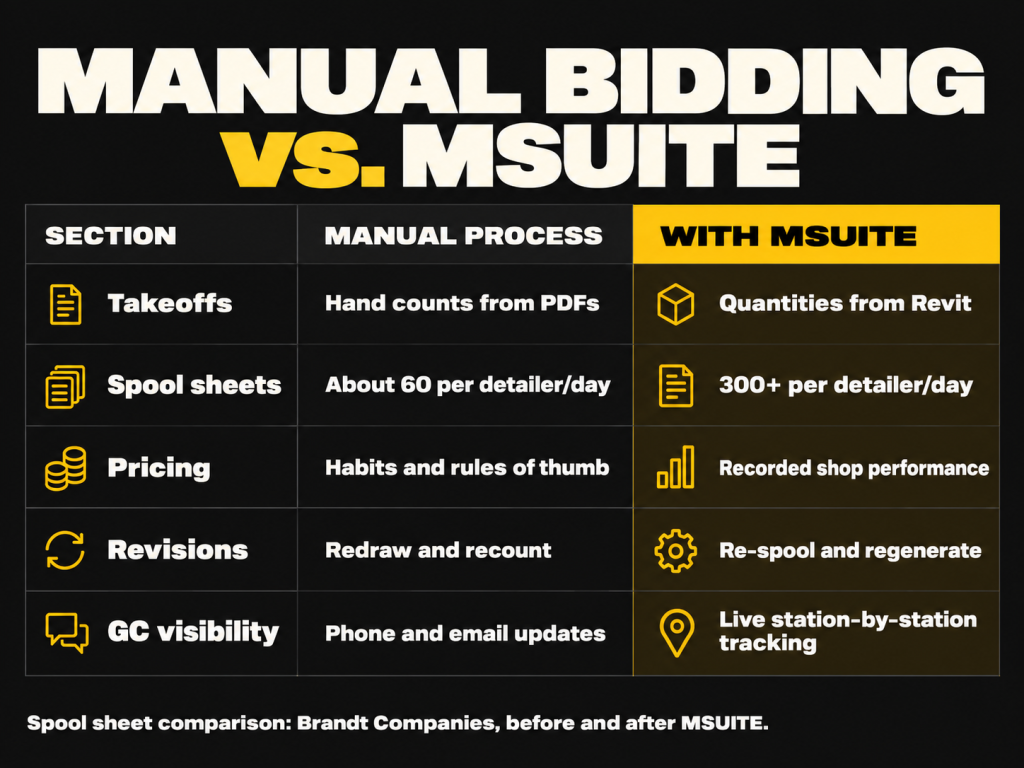
Brandt Companies saw the same effect at scale. Its VDC team went from producing about 60 spool sheets per person per day in CADmep to more than 300 using MSUITE BIM and Revit.
5x more spool sheets per detailer per day at Brandt Companies (60 to 300+)
For bidding, that capacity matters most when a GC sends a revision or asks for pricing on an alternate with a two-day turnaround. A team that can re-spool and recount in hours can respond while competitors are still redrawing.
How Does Shop Data Make an MEP Bid More Accurate?
Speed gets a bid noticed. Accuracy lets you win it without giving away margin.
Modern, a mechanical contractor in Cedar Rapids, Iowa, with more than 80 years in the market and a 90,000-square-foot facility, uses MSUITE to feed shop results back to the people who price work. Jim Tedrow, Piping Operations Leader, put it directly: “The selling point to our team for adopting technology is that it’s hard to estimate the benefits of offsite fabrication construction. Being able to leverage data in MSUITE and provide it to the Design and Estimating departments enables Modern to win more business.”
Quality records back up the price, too. Modern reports product accuracy of 95 to 98% on parts leaving the shop, a failure rate of about 2%.
95 to 98% part accuracy at Modern, roughly a 2% failure rate out of the shop
An estimator who can point to that record can carry a smaller rework allowance without taking on extra risk. For the step-by-step process of turning production history into unit rates, see our guide on how to use fabrication data to improve future bids and schedules.
How Do You Prove Shop Capability to a General Contractor?
Jackson & Blanc’s clearest example came on a renovation for a leading GC. The building’s mechanical equipment sat directly on the floor, and every office shook when it ran. The GC’s main concerns were staying on schedule, tracking every task, and limiting disruption to occupants.
While walking the building, the GC asked a pointed question: why you, and what will you do differently?
Matt Cunningham, Vice President of Operations, answered by bringing the GC’s staff to the fab shop. As the team described it: “We demoed MSUITE on the computer before the GC’s reps stepped into our shop, and then we walked station to station and showed them how staff move the material.”
Jackson & Blanc won the project and delivered it on time and on budget. Underwood summed up what the software changed: “MSUITE gives us a competitive advantage and confidence to deliver high-quality products on schedule and budget. These capabilities help a firm like Jackson and Blanc compete with much larger contractors.”
Modern takes that visibility further on industrial work. Owners can be given access to MSUITE to check where their items sit against the delivery schedule or place a piece on hold. “If we’re doing a large industrial job, MSUITE offers ‘full disclosure’ of what our fab shop is doing and what we’re working on at any stage,” Tedrow said.
What Happens After You Win More Work?
Winning more bids only pays off if the shop can absorb the volume. Jackson & Blanc expanded its fab shop from 500 square feet to 8,000 in 2017, then doubled it to 16,000 in 2018 with MSUITE in place. Underwood said growth stopped being a guessing game, because the team could push a rising number of projects through and still hold schedule and budget.
On a fast-track cooling tower and underground piping job for a pharmaceutical client, the team used MSUITE’s Refresh Sheets feature to handle field changes, such as adding a branch to a spool, without breaking and redrawing it. That kind of responsiveness is what earns the next invitation to bid.
Frequently Asked Questions
How does fabrication management software help MEP contractors win more bids?
It shortens the time needed to produce estimates and revisions, ties pricing to how the shop actually performs, and gives GCs live proof of schedule control. Jackson & Blanc credited MSUITE with helping it win a GC renovation project and compete with much larger contractors.
How can MEP contractors use BIM-to-FAB automation to produce faster project estimates?
They model fabrication parts once in Revit, then use rules-based spooling to generate spool sheets, cut lists, and bills of material automatically. Brandt Companies increased spool sheet output from about 60 to more than 300 per detailer per day with MSUITE BIM, which speeds turnaround on revisions and alternates.
Is fabrication software worth it for small and mid-sized MEP contractors?
Yes. Jackson & Blanc started with a 500-square-foot shop and now runs 16,000 square feet with MSUITE. Its shop foreman said the software lets a mid-sized firm compete with much larger contractors.
What should an MEP contractor show a GC during a shop tour?
Show how a spool moves from model to cut list to each shop station, how status updates in real time, and how changes are handled. Jackson & Blanc demoed MSUITE on screen first, then walked the GC through each station to show the workflow in action.
Show GCs Why Your Shop Wins
Request an MSUITE demo to see how MEP and industrial contractors connect BIM, FAB, and FIELD to bid faster and deliver with confidence.
Sources: Jackson & Blanc case study · Modern case study · Brandt case study · Dodge SmartMarket Brief