

Data center work pays well and moves fast, and it gives MEP subcontractors very little room to recover from a bad week.
Through September 2026, U.S. data center construction starts reached $135.8 billion across 178 projects, according to ConstructConnect. Data centers account for 27% of all nonresidential building starts this year, and the full-year total is on pace to pass $180 billion.
The schedules match the dollars. On the Crusoe campus in Abilene, Texas, DPR Construction broke ground 10 weeks after the first design meeting and reached initial turnover on the first two buildings in 11 months. Mechanical and electrical skids arrived ready to set. Owners now expect that pace, and they expect every trade to say where its work stands on short notice.
For mechanical, plumbing and sheet metal contractors, keeping up depends on how quickly and accurately information moves from the model to the shop to the jobsite. Fabrication software is what carries it.
Definition: What is data center MEP fabrication?
Data center MEP fabrication is the off-site production of pipe spools, duct, hangers, racks and equipment skids for mission-critical facilities. Assemblies are built from a coordinated BIM model and delivered to the site in install sequence. Fabrication software manages that flow: it turns model data into spool drawings and cut lists, tracks each assembly through the shop, and shows the GC and field crews what has shipped, what is on the floor and what is behind.
Why data center schedules strain traditional MEP workflows
The same work repeats at scale. A hyperscale campus can include several identical data halls. Repetition is what makes prefab pay, and it also means one error in a typical spool can be copied dozens of times before anyone in the field sees it.
The labor isn’t there. Associated Builders and Contractors estimates the industry needs 349,000 more workers in 2026, and its chief economist has pointed to megaprojects like AI data centers as a driver. In the AGC and NCCER 2026 Workforce Survey, 28% of firms had worked on a data center in the past year. Of those, 58% said data center work increased competition for skilled workers and 49% reported more wage pressure. Shifting hours from the jobsite to a controlled shop is one of the few ways to add capacity without adding people on site.
Costs are high, and designs keep moving. ConstructConnect put the median data center cost at $540.96 per square foot for January through September 2026, up 31% from a year earlier. Owners spending at that level watch every milestone. Meanwhile cooling and power specs keep changing as equipment evolves. A late change is manageable. Finding out after the shop has already built to the old revision is what hurts.
Mechanical contractors see the demand directly. In Dodge Construction Network’s *Optimizing Digital Fabrication for Mechanical Contractors* SmartMarket Brief, 30% of firms that see more fabrication on certain building types named mission-critical facilities such as data centers.
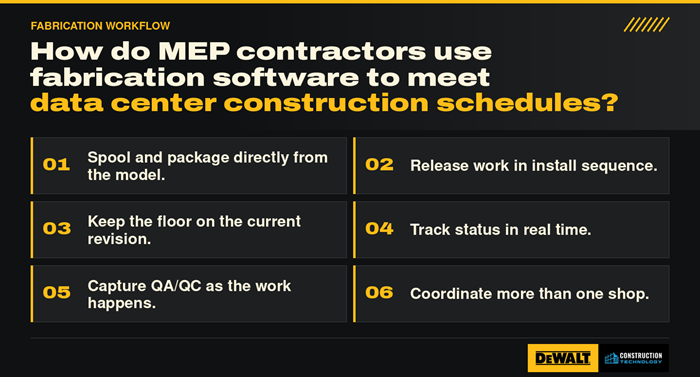
How do MEP contractors use fabrication software to meet data center construction schedules?
- Spool and package directly from the model. Spool drawings, bills of material and cut lists come out of the BIM model without re-keying. Because data halls repeat, the VDC team details a typical package once and reuses it. DPR’s president put it plainly in his account of the Abilene job: “Repeatability compounds.”
- Release work in install sequence. Field crews install by building, data hall and area. Good prefab software lets the shop group packages the same way and set due dates from the GC’s schedule, so the shop builds what the field needs next.
- Keep the floor on the current revision. Fabricators read drawings on tablets that update when the model changes. When a cooling revision lands, the PM can see which affected spools are not started, in progress or finished, and hold only those.
- Track status in real time. Each station logs start and completion. When the GC asks where a package is, the PM can answer from a dashboard: on the floor, in QA, on a truck or on site.
- Capture QA/QC as the work happens. Weld logs, heat numbers and test records attach to each spool. Mission-critical owners and commissioning agents ask for this documentation, and having it on hand keeps closeout from turning into a paperwork scramble.
- Coordinate more than one shop. Large awards can exceed a single shop’s capacity. A shared platform gives every shop, including outside fabricators, the same packages, priorities and status view.
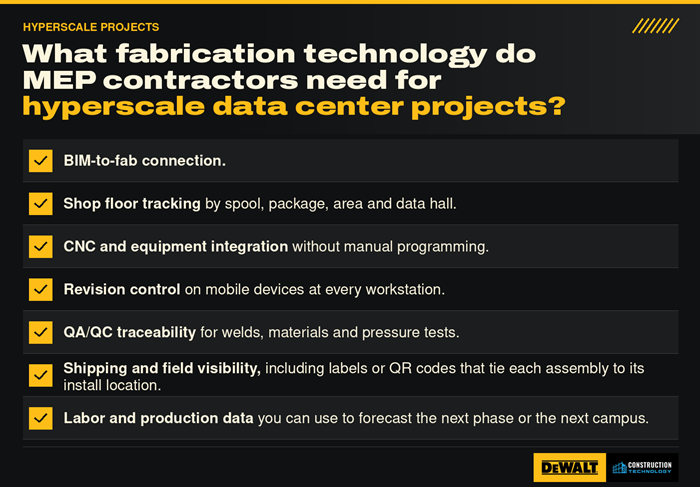
What fabrication technology do MEP contractors need for hyperscale data center projects?
Use this list to check whether your current stack can handle a hyperscale award:
- BIM-to-fab connection with spooling inside Revit and automated hanger placement, so detailing keeps pace with design.
- Shop floor tracking by spool, package, area and data hall.
- CNC and equipment export so cut lists reach saws and plasma tables without manual programming.
- Revision control on mobile devices at every workstation.
- QA/QC traceability for welds, materials and pressure tests.
- Shipping and field visibility, including labels or QR codes that tie each assembly to its install location.
- Labor and production data you can use to forecast the next phase or the next campus.
The payoff is what Limbach described on a project for a confidential hyperscaler: steel and piping fabricated in-house, assemblies pre-fit, dry-tested and packaged for a specific onsite need, then installed in one day with minimal field adjustment.
The industry is paying attention. MCAA’s 2026 Fabrication Conference in the Baltimore area featured shop tours at W.E. Bowers and focused on fabrication strategies for data center and mission-critical work.
ROI callouts for data center MEP fabrication
| Figure | Why it matters to MEP subs | Source |
| $135.8B in U.S. data center starts, Jan to Sept 2026 | Volume will keep shops full into 2027 | ConstructConnect |
| 27% of 2026 nonresidential building starts | More than one in four new nonresidential projects | ConstructConnect |
| 10 weeks to groundbreaking, 11 months to first turnover | The pace owners now use as a benchmark | DPR Construction via BD+C |
| 58% of data center contractors report more competition for skilled workers | Shop hours stretch a limited crew further | AGC/NCCER 2026 Workforce Survey |
| 33 GW to 176 GW projected U.S. data center power demand, 2024 to 2035 | Demand runs well past this cycle | Deloitte 2026 E&C Industry Outlook |
| Prefab assemblies installed in one day | Shop accuracy translates directly into field time | Limbach |
Get the system in place before the award
The worst time to change how your shop works is the week after you sign a hyperscale contract. Contractors who handle these jobs well usually set up package templates for a typical data hall, agree on a reporting cadence with the GC, and pilot their fabrication software on an earlier phase or a smaller mission-critical job. Our article on what happens to your fab shop when you win a hyperscale data center contract walks through those changes in detail.
Data center owners will keep asking for faster delivery and better visibility. MEP construction firms that can show live status by spool and package, and adjust to a design change in hours instead of days, are the ones getting invited back for phase two.
FAQ
How do MEP contractors use fabrication software on data center projects?
- They use it to spool and package directly from the BIM model, release work to the shop in install sequence, keep fabricators on the current revision, track every assembly in real time and capture QA/QC records for commissioning.
Why is prefabrication important for data center construction?
- Data center schedules are compressed and skilled labor is scarce. Prefabrication moves work into a controlled shop, takes advantage of repetitive data hall layouts and delivers assemblies ready to install, as with the ready-to-set skids on DPR’s Abilene project.
How big is the data center construction market in 2026?
- ConstructConnect reports $135.8 billion in U.S. data center construction starts from January through September 2026, about 27% of nonresidential building starts, with the full year on pace to exceed $180 billion.
What should MEP contractors look for in fabrication software for hyperscale work?
- A direct BIM-to-fab connection, tracking by spool, package and data hall, CNC export, mobile revision control, QA/QC traceability, shipping and field visibility, and production data that supports forecasting.
How do fab shops handle late design changes on data center jobs?
- Revision-controlled drawings on the shop floor and real-time spool status let the PM see exactly which assemblies a change affects, hold only those and document the impact for a change order.

DEWALT Construction Technology connects BIM, fabrication and field teams so Trade contractors can meet aggressive data center schedules. Book a demo to see MSUITE Today.
Related reading
- What Happens to Your Fab Shop When You Win a Hyperscale Data Center Contract
- 5 Metrics Every Fab Shop Needs to Track on Data Center Projects
- BIM Automation for Support System Layout
- Why Data Center Projects Demand Fabrication-Driven BIM Workflows
- Why the Most Successful Data Center Builders Run on a Connected BIM-to-Fab-to-Field Operating System
Sources
- ConstructConnect, November 2026 Data Center Report, Michael Guckes, Oct. 30, 2026
- Mark Whitson, DPR Construction, What hyperscale data centers teach the construction industry about speed, scale, and execution discipline, Building Design + Construction, April 7, 2026
- AGC of America and NCCER, 2026 Workforce Survey results, Sept. 3, 2026
- Associated Builders and Contractors via NCCER, Construction Needs 349K New Workers in 2026, Feb. 11, 2026
- Deloitte, 2026 Engineering and Construction Industry Outlook
- Dodge Construction Network, Optimizing Digital Fabrication for Mechanical Contractors SmartMarket Brief, 2025
- Limbach, Helping a Leading Hyperscaler Accelerate Their Speed to Market
- MCAA, 2026 Fabrication Conference; Construction Owners, MCAA to highlight data center fabrication during 2026 conference at W.E. Bowers