
Pipe Fabrication in 2026: The Process, the Shop Workflow and the Software That Runs It
Data center cooling loops, chilled water plants, process piping for chip fabs and power: the work that keeps mechanical and industrial contractors busy runs on pipe. The crews to install it are getting harder to find. Associated Builders and Contractors estimates the industry must attract 349,000 new workers in 2026 and 456,000 in 2027. Welding is especially tight, with roughly 320,500 additional welders needed by 2029.
That’s why more of the work is moving off the jobsite and into the shop. This guide covers what pipe fabrication is, how the process works step by step and what pipe fabrication software should do to keep a shop on schedule.
What is pipe fabrication?
Definition: Pipe fabrication is the process of cutting, beveling, fitting, welding and testing pipe, fittings, flanges and valves into finished assemblies before they are installed. Those assemblies are called pipe spools. Fabrication can happen in the field, but most contractors now do it in a controlled pipe fabrication shop, where spools are built from coordinated spool drawings, inspected and shipped to the site ready to install.
Shop fabrication vs. field fabrication
Field work is sometimes unavoidable, but a shop gives you repeatable quality, safer working conditions, less weather risk and better use of scarce welders.
The shift is already mainstream. In Dodge Construction Network’s Optimizing Digital Fabrication for Mechanical Contractors SmartMarket Brief, 71% of mechanical contractors fabricate piping and 71% fabricate welded pipe assemblies. And 82% say owners and GCs now require fabrication capability to win work.
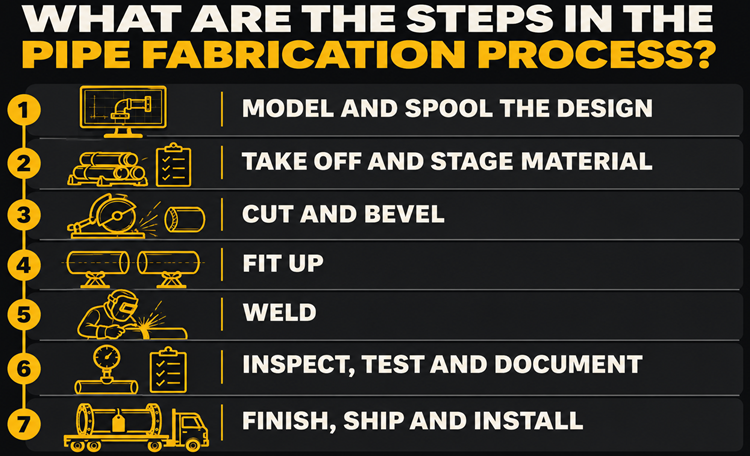
What are the steps in the pipe fabrication process?
Every shop has its own flow, but most pipe spool fabrication follows these seven steps.
1. Model and spool the design
The process starts in BIM. Detailers break the coordinated model into spools sized for shipping, handling and installation. Each spool gets a spool drawing (usually an isometric) with cut lengths, fittings, weld numbers, materials and a bill of materials. The more accurate the model, the fewer surprises downstream. Over 90% of mechanical contractors in the Dodge research now use BIM for fabrication.
2. Take off and stage material
The bill of materials drives purchasing and kitting. Pipe, fittings, flanges and valves are checked against the spool package, tagged by heat number where traceability is required and staged so fitters aren’t hunting for parts.
3. Cut and bevel
Pipe is cut to length and beveled for welding using saws, plasma, torches or machine beveling. Cut lists pulled straight from the model eliminate manual measurement errors. About 55% of mechanical contractors use automated cutting and 44% use fabrication machine control, according to Dodge.
4. Fit up
Fitters assemble the cut pieces, fittings and flanges, and tack them into position to the drawing’s dimensions and tolerances. Many industrial shops follow Pipe Fabrication Institute (PFI) engineering standards for fabricating tolerances, such as PFI ES-3.
5. Weld
Welders complete the joints using the qualified welding procedure for the material and code. Rolling welds on a positioner in the shop is faster and more consistent than position welding in a pipe rack. Robotic welding is growing too: 18% of mechanical contractors use it now, and another 39% are considering it.
6. Inspect, test and document
QA/QC confirms dimensions, visual weld quality and any required nondestructive examination (NDE), such as radiography or ultrasonic testing. For process piping, ASME B31.3 sets the requirements for materials, fabrication, examination and testing. Weld logs, welder IDs, heat numbers and inspection records become part of the turnover package.
7. Finish, ship and install
Spools may be painted, coated, insulated or cleaned. They’re then tagged with a spool ID, sequenced to the field’s install plan and delivered. Field crews install and connect them instead of building them in place.
Why is pipe fabrication moving into the shop?
Three forces are driving the shift.
- Deloitte’s 2026 Engineering and Construction Industry Outlook notes that 41% of construction workers are expected to retire by 2031. A shop lets fewer skilled welders produce more, and gives veteran tradespeople a safer place to work.
- Deloitte projects U.S. data center power demand could grow more than fivefold, to 176 gigawatts by 2035. Every one of those facilities needs cooling piping, often on aggressive schedules that reward prefabrication.
- Schedule and quality. Shop-built spools arrive tested and ready to install. Contractors in the Dodge research report better cost, schedule and quality performance from BIM-driven fabrication.
What is pipe fabrication software?
Definition: Pipe fabrication software is the set of digital tools that manages pipe spools from design to delivery. It typically covers three jobs: spooling and detailing (turning the BIM model into spool drawings and cut lists), shop production management (tracking every spool through cutting, fit-up, welding, QA/QC and shipping) and machine integration (sending cut and bend data straight to equipment).
Many shops have the first job covered and run the second on paper travelers and spreadsheets. That gap is where schedules slip. Dodge found that 54% of mechanical contractors use fabrication management software, and 87% of those users chose a commercial product over a homegrown one.
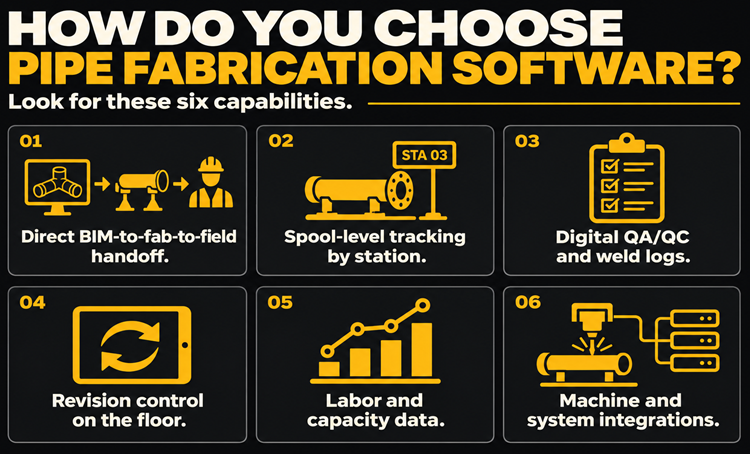
How do you choose pipe fabrication software?
Look for these six capabilities.
- Direct BIM-to-fab handoff. Spool drawings, BOMs and cut lists should come straight from the model, with no re-keying.
- Spool-level tracking by station. Fabricators update status on a tablet at cut, fit, weld and QA, so anyone can see where a spool is in real time.
- Digital QA/QC and weld logs. Weld maps, welder IDs, heat numbers and NDE results captured as work happens, not assembled at turnover.
- Revision control on the floor. Fabricators only see the current drawing. Superseded revisions are flagged automatically.
- Labor and capacity data. Actual hours against estimate by spool and package, so you can plan capacity and bid the next job tighter.
- Machine and system integrations. Connections to cutting and bending equipment, ERP and BI tools.
One more test: can your crews actually use it? Training is the top barrier to BIM-driven fabrication. In the Dodge research, 37% cite need for training and 30% cite lack of skilled expertise.
AZCO needed a better way to track progress, coordinate work, and maintain quality without adding administrative overhead.
AZCO, a Burns & McDonnell company, runs a 45,000 sq. ft. stainless and carbon steel pipe fabrication facility with 39 craft professionals and four in-house drafters. Before MSUITE, the shop ran on paper spool drawings, Excel and a homegrown system with no real-time tracking.
After rollout, with iPads deployed across welders, fit-up booths, cutters and loaders, PMs got live spool status and leadership got one dashboard across every project. The biggest return came from quality. As pipe fabrication department manager Matthew Benner put it: “QA/QC is where I’ve seen the biggest return. Everything is in one place now instead of tracking Excel spreadsheets on the side.” (Read the AZCO case study.)
ROI callouts: pipe fabrication by the numbers
| Metric | Source |
| 71% of mechanical contractors fabricate piping | Dodge SmartMarket Brief (2025) |
| 82% say owners/GCs require fabrication capability | Dodge SmartMarket Brief (2025) |
| 349,000 new construction workers needed in 2026; 456,000 in 2027 | ABC, via NCCER |
| ~320,500 additional welders needed by 2029 | Welding workforce data, via Contractor |
| 41% of construction workers expected to retire by 2031 | Deloitte 2026 E&C Outlook |
| 176 GW projected U.S. data center power demand by 2035 (from 33 GW in 2024) | Deloitte 2026 E&C Outlook |
| 18% use robotic welding today; 39% more are considering it | Dodge SmartMarket Brief (2025) |
Pipe fabrication isn’t new
What’s changed is the pressure: fewer welders, bigger and faster projects, and owners who expect prefabrication. The shops that keep up connect the model to the floor, track every spool by station and capture QA/QC as the work happens. That’s the job of pipe fabrication software, and it’s how a pipe shop turns fabrication from a reactive scramble into a predictable operation.
FAQ About Pipe Fabrication and Software
What is pipe fabrication? Pipe fabrication is the process of cutting, beveling, fitting, welding and testing pipe and components into finished assemblies, called spools, before installation. Most contractors do it in a shop, then ship spools to the jobsite ready to install.
What is pipe spool fabrication? Pipe spool fabrication is building a pre-assembled section of piping (pipe, fittings and flanges) from a spool drawing in a shop. Each spool is tagged, inspected and installed as one piece in the field.
What are the steps in the pipe fabrication process? The typical steps are design and spooling, material takeoff and staging, cutting and beveling, fit-up, welding, inspection and testing, and finishing, shipping and installation.
What does a pipe fabricator do? A pipe fabricator reads spool drawings, then cuts, fits and often tack-welds pipe and fittings to the required dimensions and tolerances. Certified welders complete the joints, and QA/QC inspects the finished spool.
What is pipe fabrication software? Pipe fabrication software manages spools from design to delivery: creating spool drawings and cut lists from BIM, tracking each spool through the shop, recording weld and QA/QC data, and sending data to cutting and bending machines.
What codes apply to pipe fabrication? It depends on the system. ASME B31.3 covers process piping, ASME B31.1 covers power piping and ASME B31.9 covers building services piping. Many industrial shops also follow Pipe Fabrication Institute (PFI) engineering standards.
MSUITE connects BIM, the fabrication shop and the field so every pipe spool is tracked from model to install. See MSUITE’s pipe fabrication software in action: book a demo →
Related reading:
- Piping Fabrication 101: What Does It Involve?
- The Future of Pipe Fabrication
- Pipe Spool Fabrication: Process, Benefits and How to Optimize Production
- Spool Tracking: How to Eliminate Status Guesswork
- How BIM Improves Pipe Spool Fabrication and Shop Production
- How AZCO Brought Real-Time Control to Fabrication