
Most sheet metal shops have spent real money on machines. Coil lines, plasma tables and spiral formers have changed how fast duct can be made. An automated rectangular coil line can turn out finished duct with one or two operators, while the manual route still depends on a larger crew.
The information around those machines often hasn’t caught up. Cut lists still get printed, fittings still get tracked on clipboards, and the PM still calls the shop to find out whether level 3 shipped. A faster coil line doesn’t help much if it’s waiting on the next job or cutting the wrong one.
Hiring won’t close the gap on its own. The U.S. Bureau of Labor Statistics counts 131,100 sheet metal workers and projects 3% growth from 2025 to 2035, about as fast as the average for all occupations. The extra output has to come from the people and equipment shops already have.
What is duct fabrication management software?
Duct fabrication management software (also called sheet metal fabrication software) runs the information side of an HVAC sheet metal shop. It imports fitting data from the fabrication model, routes each item to the right machine or station, tracks status and labor by drawing and package, measures output by weight, and shows the field what has shipped. It replaces printed cut lists, spreadsheets and whiteboards with one live record from model to jobsite.
How is duct fabrication software different from pipe spool software?
Both track work from model to field, but the shop floors run on different units. Software built only for pipe usually struggles with sheet metal for the reasons below.
| What changes | Sheet metal / duct shop | Pipe spool shop |
| Unit of work | Individual fittings and duct sections, often thousands per job | Spools, typically fewer and heavier |
| Productivity measure | Pounds fabricated per labor hour | Welds or factored diameter inches (FDI) per day |
| Model data | MAJ job files from Autodesk Fabrication CADmep or Revit | Spool drawings, isometrics and cut lists |
| Key machines | Coil lines, plasma tables, spiral formers, seamers, brakes | Saws, bevelers, welding positioners, robotic welders |
| Quality checks | Gauge, seam, reinforcement and seal class per SMACNA duct standards | Weld logs, heat numbers, NDE and pressure tests |
| Shipping | Many loose pieces kitted by floor, area or riser | Tagged spools staged by system and area |
The SMACNA HVAC Duct Construction Standards set gauge, reinforcement and sealing requirements by pressure class, so a duct shop’s quality checks look nothing like a weld log. Good sheet metal software tracks by weight and by fitting, reads MAJ files natively and supports a workflow built around duct machines.
How does duct fabrication software improve sheet metal shop productivity?
- It reads the model directly. Importing MAJ files from CADmep or Revit removes the step where someone retypes fitting data or rebuilds a cut list. That’s time saved on every job and one less place for a wrong dimension to start.
- It routes work to the right machine. Straight duct goes to the coil line, fittings to plasma, round to the spiral former. Each station sees its own queue in priority order instead of a stack of paper on a table.
- It measures output by weight. Pounds per labor hour, tracked at the drawing and package level, gives sheet metal shops a fair productivity number that counts a heavy 14-gauge plenum differently from a light branch fitting. Compare it to the estimate while the job is still running.
- It keeps machines fed. When the shop can see what’s released, what’s next and what material is on hand, it can batch work by gauge and material to cut changeovers and keep expensive equipment busy.
- It tracks every piece to the truck. Labels or QR codes tie each fitting to its package and install location. Crews kit by floor or riser, and the field gets complete shipments instead of a scavenger hunt.
- It shows capacity before you commit. Comparing loaded work against available hours tells the shop manager whether a due date is realistic before promising it to the PM.
- It fits how your shop already works. Configurable statuses, routing and custom fields let the software follow your process, which makes adoption on the floor much easier.
What it looks like in a real shop
Streimer, a family-owned HVAC and plumbing contractor in the Pacific Northwest, was managing more than 10,000 work packages a year with Excel and disconnected processes. Order tracking, manpower planning and delivery scheduling all suffered.
After consolidating onto MSUITE FAB, Streimer now manages more than 90,000 fabrication hours a year and 17,000 to 28,000 items a month, and reports zero lost orders. Mark Van Sickle, VP of manufacturing, described the platform as “a catalyst for organizational efficiency” that “significantly improved the quality and amount of data available to manage our capacity and processes.”
Named stats and ROI callouts
| Figure | Source |
| 131,100 U.S. sheet metal workers; 3% projected growth, 2025 to 2035 | U.S. Bureau of Labor Statistics |
| About 9,800 projected openings a year for sheet metal workers | U.S. Bureau of Labor Statistics |
| 1 to 2 operators to run an automated rectangular coil line | ACHR News, 2026 equipment guide |
| Approximately 10,000+ work packages a year, previously managed in Excel | Streimer case study |
| Approximately 90,000+ fabrication hours a year and 17,000 to 28,000 items a month now tracked | Streimer case study |
| Zero lost orders reported | Streimer case study |
Getting technology started in the fab shop
Start where the paper is heaviest. For most duct shops, that’s the handoff from detailing to the floor and the handoff from the floor to shipping. Bring MAJ files straight into your fabrication software, put tablets at the main stations and start capturing pounds and hours by package. Within a few weeks you’ll have a productivity baseline most shops have never had. The equipment guide in ACHR News makes a point that applies here too: match automation to your actual weekly output, not your busiest week. Real production data is how you find that number.
Sheet metal is a large part of MEP fabrication, and duct shops deserve tools built for how they actually work. Machines set the speed limit. Software decides how close you get to it.
FAQ for duct fabrication software
How does duct fabrication software improve sheet metal shop productivity?
- It imports fitting data from the model, routes work to the right machines, tracks status and labor by package, measures output in pounds per hour, labels every piece for shipping and shows whether due dates fit available capacity. That removes manual data entry and keeps equipment and crews working on the right job.
What is duct fabrication management software?
- Software that manages the flow of information in an HVAC sheet metal shop, from model import through cutting, assembly, quality checks and shipping, with productivity tracked by weight and status visible to the PM and field.
How is duct fabrication software different from pipe spool software?
- Duct shops track thousands of individual fittings by weight, import MAJ files, run coil lines and plasma tables and check gauge and seal class. Pipe shops track spools by welds or FDI and record weld logs and heat numbers. Software built for one usually needs real changes to serve the other.
What is a good productivity metric for a duct shop?
- Pounds fabricated per labor hour, tracked by drawing and package and compared against the estimate.
Can one platform manage both sheet metal and pipe fabrication?
- Yes, if it supports trade-specific workflows, units and file types. Multi-trade contractors benefit from one system for status and capacity across shops.
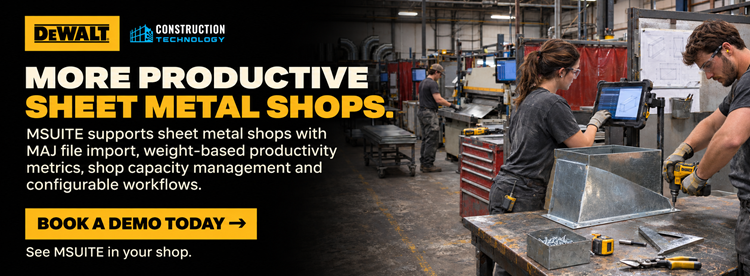
MSUITE supports sheet metal shops with MAJ file import, weight-based productivity metrics, shop capacity management and configurable workflows. Book a demo today to see MSUITE in your shop.
Related reading
- Why Sheet Metal Contractors Need Shop Management Software
- The Next Era of Sheet Metal Fabrication
- Boost Your Sheet Metal Shop’s Performance with Weight & Time Sheet Metrics
- Streimer Enhances Operations with MSUITE
Sources
- S. Bureau of Labor Statistics, Occupational Outlook Handbook: Sheet Metal Workers, updated Oct. 29, 2026
- Ryan Tao, Bringing Duct Fabrication In-House: A 2026 Equipment Guide for Sheet Metal Shops, ACHR News, July 6, 2026 (author is an equipment supplier)
- SMACNA, HVAC Duct Construction Standards: Metal and Flexible, 4th Edition
- MSUITE, Streimer Enhances Operations with MSUITE case study
- MSUITE, Sheet Metal product sheet