
For most MEP executives, the real story of a fabrication shop doesn’t show up until it’s too late. A schedule slips two weeks before a delivery. A crew sits idle waiting on a spool that was actually finished days ago but never logged. A COO finds out about a bottleneck in a Monday morning status meeting instead of the moment it started.
That’s the management visibility gap: leadership making decisions on information that’s already stale. A real-time shop dashboard closes that gap. Instead of waiting for someone to compile a report, executives can see exactly what’s happening on the shop floor as it happens, and shift from reacting to problems to preventing them.
What Is a Real-Time Shop Analytics Dashboard?
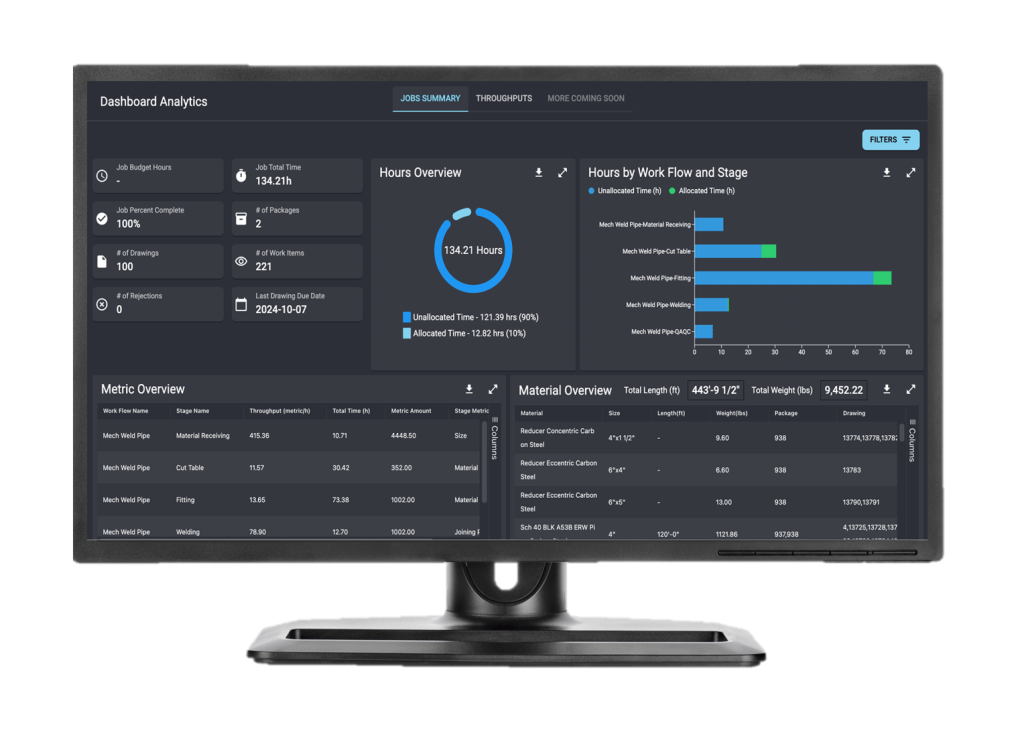
A real-time shop dashboard is a live view of fabrication production (throughput, labor hours, material status, and schedule adherence, etc.) pulled directly from shop-floor activity instead of manual reports. Rather than a spreadsheet someone updates at the end of the week, the dashboard reflects what’s actually happening at each station right now, giving managers, directors, and VPs a single source of truth for how the shop is performing against plan.
Why the Visibility Gap Costs More Than It Looks Like
Fabrication shops generate an enormous amount of production data: hours worked, spools completed, material consumed, packages shipped, and so forth. The problem isn’t a lack of data. It’s that the data usually lives in disconnected places: paper travelers, individual spreadsheets, a supervisor’s memory. By the time it reaches an executive, it’s been summarized, delayed, or lost altogether.
That delay has real consequences. According to Deloitte’s 2026 engineering and construction industry outlook, labor constraints and margin pressure mean firms can’t afford to discover production problems after the fact. They need to catch them early enough to act. And Dodge Construction Network’s 2026 SmartMarket Brief on digital fabrication, based on a survey of 197 mechanical contractors, found that mechanical contractors using BIM-driven, connected fabrication processes rated schedule performance as better or much better 75% of the time, compared with traditional site-built work. That’s the visibility-to-outcome connection in one number: contractors who can see production clearly plan and deliver more predictably.
Named Stats: What Connected Shops Are Actually Reporting
A few figures worth putting in front of a leadership team:
- 75% of mechanical contractors say BIM-driven, digitally connected fabrication improves schedule performance compared with traditional site work (Dodge Construction Network SmartMarket Brief, 2026).
- 54% of mechanical contractors already use dedicated fabrication management software to improve productivity, and adoption is highest among larger firms (Dodge Construction Network).
- 5x: the increase in spool sheet output (from roughly 60 to over 300 per day) Brandt Companies achieved after connecting BIM-to-FAB workflows with real-time shop tracking, with a 30 to 35 percent reduction in material waste.
- 40% increase in fabrication throughput reported by contractors after adopting connected, analytics-driven shop workflows.
- Construction productivity overall could grow by 50–60% through digitization and process integration, according to a McKinsey Global Institute analysis.
None of these gains start with better labor or better equipment. They start with visibility: knowing where things actually stand so leadership can act on real information instead of guesses.
What Shop Floor Dashboards Should MEP Executives Actually Track?
Not every metric belongs on an executive dashboard. The ones that matter most for decision-making are:
- Throughput: total output over time, and where it’s dropping
- Schedule adherence / on-time delivery rate: percentage of packages delivered to the field on schedule
- Labor efficiency: actual hours worked versus budgeted hours, by package or crew
- Material waste and utilization: what’s being consumed versus scrapped
- First-pass yield: the percentage of assemblies that pass inspection without rework
- Equipment and station utilization: where machines and crews sit idle
Tracked together, these metrics tell an executive not just what happened last week, but where the next bottleneck is likely to form.
Manual Reporting vs. Periodic Reports vs. Real-Time Dashboards
| Manual / Spreadsheet Tracking | Periodic (Weekly) Reports | Real-Time Shop Dashboard | |
| Data freshness | Hours to days old | Days to a week old | Live, as production happens |
| Source of data | Manual entry, paper travelers | Compiled from multiple manual sources | Pulled directly from shop-floor activity |
| Bottleneck detection | After the fact | After the reporting cycle closes | As it happens |
| Executive decision-making | Reactive | Delayed and reactive | Proactive |
| Scales across multiple shops | Difficult, inconsistent | Labor-intensive to compile | Standardized, real-time across locations |
The ROI of Real-Time Visibility
For a leadership team weighing whether dashboard-driven visibility is worth the investment, the return shows up in a few concrete places:
- Schedule certainty: Contractors using connected, real-time fabrication tracking report meaningfully better schedule performance than those relying on manual or periodic reporting, directly reducing the risk of costly field delays.
- Labor recovery: Every hour a manager spends chasing status updates by phone or walking the floor is an hour not spent on production planning. Real-time dashboards return that time to higher-value work.
- Material savings: Contractors connecting shop data to design and procurement have documented 30 to 35 percent reductions in material waste, waste that otherwise erodes margin project after project.
- Faster course correction: Instead of discovering a labor or material shortfall at project close-out, executives can reallocate resources the same day a dashboard flags a slipping station.
Seeing It in Practice
Watching how this plays out day to day is often more useful than any single statistic. In this case study, a mechanical contractor’s leadership team, including operational and executive perspectives, walks through how moving to real-time shop visibility changed the way they plan, staff, and make decisions: watch the case study.
Frequently Asked Questions
What shop floor dashboards should MEP executives use to track fabrication performance?
Executives get the most value from dashboards that combine throughput, schedule adherence, labor efficiency, material waste, and first-pass yield in one live view, rather than isolated reports from different departments. The goal is a single source of truth that updates as production happens, so leadership can compare planned versus actual performance without waiting on someone to compile it.
How do fabrication analytics help MEP contractors improve schedule predictability?
Fabrication analytics turn scattered shop-floor activity into a consistent, comparable data set. By tracking metrics like throughput and on-time delivery rate over time, contractors can identify recurring bottlenecks, benchmark performance across projects or shop locations, and catch early signs that a package is falling behind schedule before it turns into a missed delivery date.
Is real-time shop tracking only useful for large fabrication operations?
No. While larger contractors have been the fastest to adopt dedicated fabrication management software, the visibility gap affects shops of every size. Smaller and mid-size operations often feel the cost of reactive management even more acutely, since they have less staff capacity to absorb the time lost to manual status checks.
Does a real-time dashboard replace the need for weekly production meetings?
Not entirely, but it changes what those meetings are for. Instead of spending time establishing what happened last week, teams can spend the meeting deciding what to do about it, because everyone is already looking at the same current data.
See It on Your Own Shop Floor
Reactive fabrication management isn’t a staffing problem. It’s a visibility problem. MSUITE’s real-time production dashboards give MEP executives a live view of throughput, labor, and schedule performance across every shop, so decisions get made before a problem becomes a delay.
Request a free MSUITE demo to see how real-time visibility changes the way your leadership team plans, staffs, and delivers.