

Every sheet metal shop has a version of the same story. A duct run gets modeled one way, cut another way, and installed a third way. Somewhere between the model and the field, a foot of waste here and an hour of rework there add up to a real hit on margin. None of it shows up as a single dramatic failure. It shows up as a shop that never quite hits the schedule it planned.
That gap between BIM, fabrication, and field is exactly where lean manufacturing principles apply to prefabrication, and it is why SMACNA contractors are increasingly borrowing from the same playbook that transformed automotive and industrial manufacturing decades ago.
What Is Lean Fabrication?
Lean fabrication applies the core idea of lean manufacturing, eliminate anything that does not add value for the customer, to the shop-and-field workflow of MEP and sheet metal production. According to the Lean Construction Institute, lean construction identifies eight forms of waste: defects, overproduction, waiting, unused talent, transportation, excess inventory, unnecessary motion, and extra processing.
For a sheet metal or pipe fab shop, those eight wastes have familiar faces:
- Defects are spools or duct sections cut wrong because the MAJ file or Revit model was out of date.
- Overproduction is fabricating more than the field needs before a schedule change hits.
- Waiting is crews standing around because a status update never made it from the shop to the jobsite.
- Excess inventory is remnant steel and duct offcuts sitting in a corner because nesting wasn’t optimized.
- Extra processing is a foreman re-entering the same production data into a spreadsheet that already exists somewhere else.
Lean fabrication is not a single tool. It is a way of running the shop so that every handoff, from coordination to cutting to installation, moves information and material with as little friction as possible.
Why This Matters More in 2026
The pressure to run lean is not theoretical. Deloitte’s 2026 Engineering and Construction Industry Outlook points to a labor gap the industry needs roughly half a million workers to close, alongside rising material costs and a workforce nearing retirement. At the same time, demand tied to data center and energy infrastructure work is pushing schedules tighter, not looser.
Dodge Construction Network’s Optimizing Digital Fabrication for Mechanical Contractors research backs this up from the shop floor. Contractors who use BIM-driven fabrication report efficiency gains across most cutting, bending, and joining equipment, and more than three-quarters say BIM and fabrication have a measurable positive impact on sustainability goals, largely through reduced material waste.
Put simply: shops cannot hire their way out of the labor shortage, and material costs leave little room for scrap. Lean fabrication, supported by connected BIM-to-fab-to-field software, is one of the few levers left that improves output without adding headcount.
How to Apply Lean Principles from BIM to Field
Lean fabrication works best as a sequence, not a one-time project. Here is the process SMACNA contractors are using to reduce waste at each handoff.
- Standardize the model before it reaches the shop. Enforce naming conventions, spool and rack standards, and complete material data at the BIM stage. A model with a clean bill of materials prevents the shop from guessing.
- Automate the translation from BIM to fabrication. Manual re-entry of MAJ files or Revit exports is where errors creep in. Direct BIM-to-fab automation keeps spool and duct data accurate from the model to the cut table.
- Nest and cut with waste reduction built in. Integrated cut lists and nesting logic reduce scrap by optimizing how material is used across a run, instead of cutting job by job.
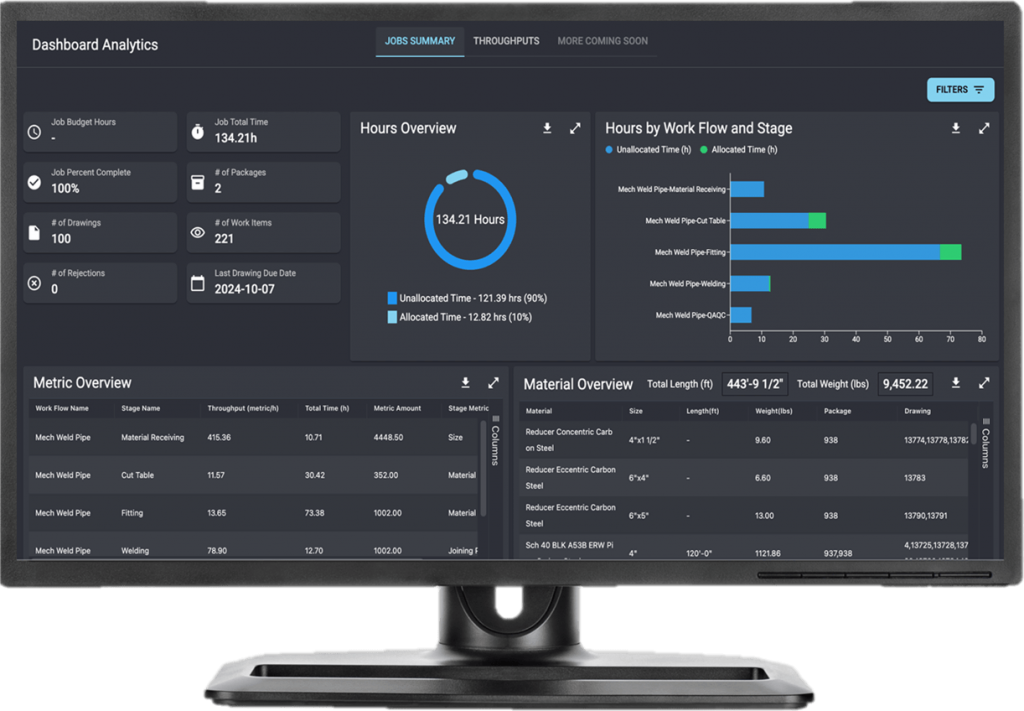
- Track weight and time at the drawing and package level. Weight-based production data paired with time sheet metrics shows exactly where labor and material are going, not just what was estimated.
- Give the field real-time visibility into shop status. Idle crews waiting on assemblies are a form of waiting waste. Real-time status tracking prevents installers from showing up to a jobsite with nothing ready to install.
- Feed field data back into the next model. Lean is a loop. Actual labor hours, rework rates, and material usage should inform how the next project is modeled and estimated.
Named Stats: What Lean Fabrication Delivers
Contractors applying these principles with connected fabrication software report consistent, measurable results:
- 30 to 35 percent reduction in material waste for shops that automate spool and cut data from BIM.
- Up to five times faster spool sheet creation when spool generation is automated instead of manual.
- 25 percent increase in throughput within the first six months of adopting real-time production analytics.
- 50 percent faster reporting cycles when dashboards replace manual spreadsheet reporting.
- 60 to 84 percent of contractors report efficiency gains across major fabrication equipment types when using BIM-driven fabrication, per Dodge Construction Network.
- 20 percent or more productivity gains in manufacturing operations that adopt AI-assisted forecasting and pattern recognition, according to McKinsey.
ROI Callout: What Waste Reduction Is Worth
For a mid-size sheet metal shop running $15 million in annual fabricated work, a 30 percent cut in material waste on a typical 3 to 5 percent scrap rate translates into roughly $135,000 to $225,000 back on the bottom line each year, before accounting for the labor hours saved on rework and re-cutting. Add a 25 percent throughput gain, and the same crew produces more billable work without a single new hire.
That is the pitch lean fabrication makes to ownership: this is not a productivity initiative measured in soft benefits. It is a margin initiative measured in dollars.
Proof from the Shop Floor
Streimer, one of the Pacific Northwest’s top sheet metal fabricators, adopted MSUITE to gain visibility across shop capacity, labor allocation, and material flow. As Mark Van Sickle, VP of Manufacturing at Streimer, put it, the platform became “a catalyst for organizational efficiency,” improving the quality and amount of data available to manage capacity and processes. You can read the full Streimer case study for the complete results.
Frequently Asked Questions
What is lean fabrication and how does it reduce waste in MEP construction?
Lean fabrication applies manufacturing lean principles, eliminating defects, overproduction, waiting, excess inventory, and unnecessary processing, to the shop and field workflow. It reduces waste by standardizing data at the model stage, automating BIM-to-fab translation, and giving shop and field teams real-time visibility into production status.
How do MEP contractors apply lean manufacturing principles to prefabrication?
Contractors apply lean by standardizing BIM models before fabrication, automating spool and cut list generation, tracking weight and labor metrics at the package level, and feeding actual production data back into future estimates and models. The goal is a closed loop where every handoff adds value instead of introducing errors.
Do lean fabrication principles apply to sheet metal and duct work, not just pipe?
Yes. Sheet metal shops face the same eight wastes as pipe fabrication. MAJ file automation, weight-based production tracking, and configurable workflows apply directly to duct fabrication and are increasingly standard at SMACNA member shops.
What is the fastest way to start reducing fabrication waste?
Start with a single high-waste area, typically material nesting and cut list generation, and measure scrap rate before and after automating that one step. Most shops see measurable gains within a single project before expanding lean practices shop-wide.
Does lean fabrication require replacing existing BIM software?
No. Lean fabrication software connects to existing BIM platforms like Revit and Autodesk Fabrication CADmep rather than replacing them. The goal is closing the gap between design and production, not starting over.
Bringing Lean Fabrication to Your Shop
Waste rarely announces itself. It shows up as a slightly high scrap bin, a foreman re-keying data that already exists, or a crew standing around waiting on a status update that never came. Lean fabrication gives sheet metal and MEP shops a framework for finding that waste and a set of tools for eliminating it, one handoff at a time.
MSUITE, a key solution of DEWALT Construction Technology, connects BIM, fabrication, and field data into a single platform so shops can track weight, time, and material waste at every stage of production. Schedule a demo to see how a connected shop reduces waste from the model to the install.
Sources and Additional Resources
- Deloitte 2026 Engineering & Construction Industry Outlook
- Dodge Construction Network – Optimizing Digital Fabrication for Mechanical Contractors, SmartMarket Brief
- Lean Construction Institute – The 8 Wastes of Lean Construction
- McKinsey – How Manufacturing’s Lighthouses Are Capturing the Full Value of AI
- SMACNA – Sheet Metal and HVAC Standards
- ASME – Codes and Standards
- Streimer Case Study
- MSUITE FAB Product Page