
How do MEP contractors standardize quality control across multiple fabrication shop locations?
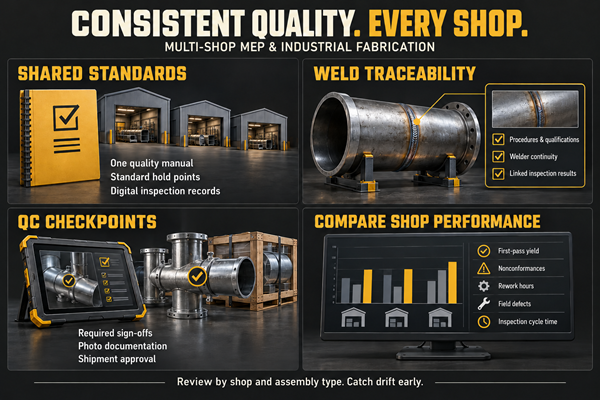
MEP contractors standardize quality control across multiple fabrication shops by running every location on one inspection standard, one digital record per assembly, and one shared defect dataset. The shops can keep different equipment, layouts, and crew sizes. They cannot keep different definitions of “done.” The contractors that get this right move QC checkpoints into fabrication software, tie each checkpoint to a spool or assembly ID, and review defect data across all locations every week, so drift gets caught in the shop instead of on the jobsite.
That matters more in late 2026 than it did three years ago. FMI’s labor productivity research found MEP contractors route 16 to 18 percent of craft hours through prefabricated assemblies and expects that share to reach 34 percent within five years. Associated Builders and Contractors estimates the industry needs 349,000 net new workers in 2026 and 456,000 in 2027. Deloitte’s 2026 Engineering and Construction Outlook projects roughly 1.8 percent growth in structures investment, with AI data centers and energy infrastructure carrying most of it. More volume is moving into shops, fewer experienced hands are available to check it, and the projects driving growth are the least tolerant of defects.
What Is Multi-Shop Quality Control?
Multi-shop quality control is a single system of inspection standards, hold points, documentation, and corrective action that applies the same way at every fabrication facility a contractor operates, regardless of location, crew, or equipment. It replaces shop-level habits with an enterprise standard that every assembly is measured against.
Why Does Quality Drift Between Fab Shops?
Quality drift rarely starts with bad workmanship. It starts with good people filling gaps differently. One shop foreman adds a dimensional check to the traveler. Another keeps weld records in a binder. A recently acquired shop still runs the inspection form it used before the deal closed. Each choice is reasonable on its own. Across a network, they produce assemblies that look identical on the drawing and arrive different in the field.
Jim Rose, who led prefabrication and packaging at Rosendin until 2022, made this point in his 2026 NECA Show session on scaling prefab across multiple shops: contractors need complete agreement on what a package looks like and how it should perform once installed. Without that shared definition, every shop builds to its own interpretation.
Disconnected information makes it worse. An FMI study of nearly 600 U.S. construction professionals found that miscommunication and poor project data caused 48 percent of all rework on U.S. jobsites, about $31.3 billion in 2018. In a multi-shop network, poor project data usually means three sources of truth for the same spool.
What Does the Research Say About QA/QC and Rework?
The case for standardizing is better quantified than most contractors realize.
- Rework eats about 5 percent of project cost. Construction Industry Institute research at the University of Texas at Austin puts rework from poor quality at roughly 5 percent of project cost on U.S. commercial work. For a contractor running $200 million a year, that is $10 million.
- Bad data carries a dollar figure. FMI calculated that a contractor with $1 billion in revenue could lose up to $165 million to bad data, including $7.1 million in avoidable rework.
- Data quality is a common problem. In a 2023 Dodge Construction Network survey of more than 200 U.S. general contractors, 46 percent reported frequent issues with the accuracy, completeness, or consistency of the data they collect.
- Prefab itself improves quality. In the Dodge Data & Analytics Prefabrication and Modular Construction SmartMarket Report, produced with the Mechanical Contractors Association of America, about 90 percent of respondents reported improved quality compared with stick-built methods.
The same Dodge study surfaced the finding multi-shop operators should read twice: most contractors rarely check whether a process change actually worked. Without that feedback, a systemic error such as a wrong flange rating or a misread revision can be replicated across three shops working the same data center package before anyone sees the pattern.
Only 20% of U.S. contractors use metrics at least half the time to judge whether a process improvement worked. (Dodge Construction Network, 2023)
How Do MEP Contractors Standardize Quality Control Across Multiple Fab Shops?
1. Write one enterprise quality standard, then make shops justify exceptions
Start with a single quality manual that covers every assembly type the network builds. Shops can request exceptions for equipment or code differences, but each exception is documented, approved centrally, and visible to every location. Rose recommends the process also define how tolerable exceptions get handled, so variation is managed instead of hidden.
2. Define hold points by assembly type
A pipe spool, a duct section, a multi-trade rack, and an electrical assembly need different checks. For each, set the hold points that must be signed off before work moves forward: material verification, fit-up and dimensional checks, weld visual, pressure or continuity testing, and labeling before shipment. Identical assembly types get identical hold points at every shop.
3. Give every assembly one digital identity
Each spool or assembly should carry a barcode or QR label that links back to its model, revision, inspections, weld records, and shipping status. This is where purpose-built fabrication software earns its keep. MSUITE, part of DEWALT Construction Technology, connects BIM, FAB, and FIELD for MEP and industrial fabrication, assigns that identity when the spool is created so the record follows the assembly from model to install. MSUITE FAB carries inspection status alongside production status, so QC is visible in the same view managers already use to run the shop.
McCarl’s, which runs fabrication across several shops, saw the effect directly. “MSUITE’s centralized, user-friendly system streamlines drawing distribution and lets multiple shops work on the same project with less confusion,” said Jon Bushmire, Operations Manager at McCarl’s.
4. Qualify procedures and people at the enterprise level
For piping work, welding procedure specifications, procedure qualification records, and welder continuity should be tracked centrally, not shop by shop. A welder qualified in one facility who covers a shift at another should carry the same record. Central tracking also shows when a procedure is about to lapse at one location before an inspector finds it.
Capturing that data at the source also changes what the QC team spends its day on. “MSUITE transformed QC by automating quality documents and letting fitters and welders instantly record heat numbers, procedures, and completed welds,” said Max Wimer, Project Engineer at McCarl’s.
5. Capture inspections at the station, not at the end of the shift
Sign-offs entered from memory at 4 p.m. are where records go wrong. Put tablets or scanners at inspection stations so the inspector scans the assembly, records the result, and attaches a photo in the moment. Station-level capture also produces the timestamps you need to see whether QC itself is becoming a bottleneck.
6. Use one defect taxonomy and review it across shops weekly
If Shop A logs “bad fit-up” and Shop B logs “dimensional NCR,” you cannot compare them. Standardize defect codes, root-cause categories, and severity levels. Then hold a weekly cross-shop review of nonconformances per 100 assemblies, first-pass yield, and rework hours. Patterns that stay invisible inside one shop stand out when four are side by side.
7. Close the loop with field feedback
The field is the final inspector. Give foremen a simple way to scan a received assembly and flag issues against its ID, then route those reports back to the shop that built it. Rose recommends scheduled feedback sessions between shop and field. Hermanson reached a similar conclusion after expanding its pipe fabrication operation in 2026: a bigger shop only performs when detailing, purchasing, fabrication quality, and logistics run as one coordinated process.
Quality training averaged 0.5 hours a month on projects studied by the Construction Industry Institute, versus 3 hours for safety. A shared QC standard only holds if crews at every shop are trained on it. (CII, Making Zero Rework a Reality)
What Changes When QC Lives in Prefab Software?
Moving quality control out of binders and spreadsheets into prefab software changes who can see it. Executives see first-pass yield by shop without waiting for a monthly report. Project managers see which assemblies on their job passed inspection before the truck leaves. Field crews see inspection history when a spool arrives. Dodge found that contractors using automated data-gathering and analysis tools reported above-average performance improvements compared with those still relying on manual methods. Standardized QC applies that same principle to the shop floor.
“QA/QC delivered our biggest return because everything now lives in one place instead of separate Excel spreadsheets.” Matthew Benner, Pipe Fabrication Department Manager, AZCO
For contractors growing by acquisition, this is also the fastest way to integrate a new shop. Instead of rewriting habits through training alone, the new location gets the same hold points, defect codes, and assembly records on day one.
Frequently Asked Questions
What quality control processes should multi-shop MEP fabrication operations use?
Multi-shop MEP fabrication operations should use a single enterprise quality manual, standardized hold points for each assembly type, digital inspection records tied to each spool or assembly ID, and a shared defect taxonomy. Cross-shop reviews of nonconformance rates and first-pass yield should run weekly so drift is caught early.
How do you keep weld quality consistent across multiple fabrication shops?
Keep weld quality consistent by managing welding procedure specifications, procedure qualification records, and welder continuity in one central system that every shop uses. Link weld inspection results to each spool’s digital record so any weld can be traced to the welder, procedure, and inspector regardless of which facility built it.
Can prefab software enforce the same QC standards at every shop?
Yes. Prefab software can require the same hold-point sign-offs before an assembly advances, capture inspection results with photos at the station, and hold shipment until required checks are complete. Because every shop works from the same configuration, the standard is enforced by the workflow rather than by memory.
What QC metrics should a multi-shop fabrication network track?
Track nonconformances per 100 assemblies, first-pass yield, rework labor hours, field-reported defects traced back to the originating shop, and inspection cycle time. Compare each metric by shop and by assembly type to find which location or product line is drifting.
See Multi-Shop Fabrication Shop Software QC in Action
If your network has more than one fab shop and more than one way of checking work, schedule an MSUITE demo to see how contractors standardize inspections, traceability, and defect tracking across every location from one platform.
Sources
-
- FMI / MSUITE: Prefabrication share of MEP craft hours
- Associated Builders and Contractors: Construction needs 349,000 workers in 2026
- Deloitte: 2026 Engineering and Construction Industry Outlook
- EC&M: Maintaining Quality Across Multiple Prefab Shops (NECA 2026)
- ACHR News: Hermanson’s pipe fabrication expansion (Sept 2026)
- FMI / PlanGrid: Construction Disconnected (2018)
- IRMI: Cost of Quality in Commercial Construction (cites CII rework research)
- Construction Industry Institute: Making Zero Rework a Reality (RT-203)
- FMI: Harnessing the Data Advantage in Engineering and Construction
- Dodge Construction Network: Contractors key to better project performance (2023)