

Traditional hanger coordination is often a manual, after-the-fact process that can introduce new clashes, delay fabrication, and increase field rework. A modern BIM-integrated hanger workflow allows contractors to model hangers alongside MEP systems and automate placement as the design evolves. In one documented customer deployment, this approach reduced average hanger installation time from significantly while lowering labor requirements.
Hanger coordination doesn’t get much attention in the pre-construction schedule. It should. For most mechanical contractors, hanger and support placement is treated as a final housekeeping task, something to handle after the model is clash-free and systems are routed. That sequencing is exactly why hangers cause so much pain later.
Here is what that traditional sequence actually looks like, and why leading mechanical contractors are replacing it with a modern, automated approach.
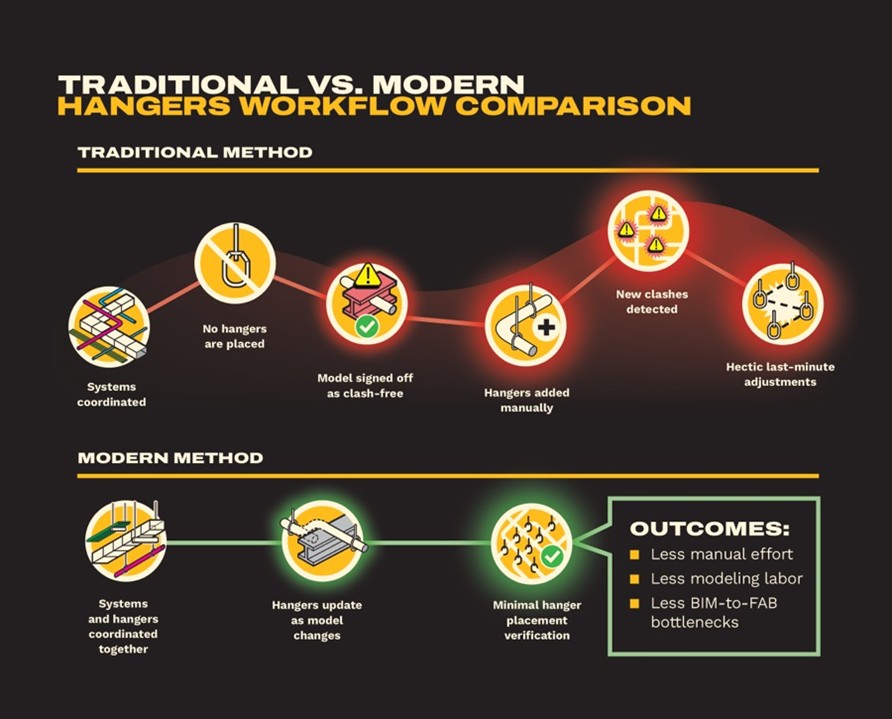
Why Traditional Hanger Workflows Break Down
In most fab shops and VDC departments, hanger coordination follows a predictable, painful pattern:
- Systems get routed and coordinated, but hangers are ignored.
- The model is signed off as clash-free without a single support in place.
- Hangers get added manually, one at a time, after the fact.
- That manual placement introduces new clashes the team never anticipated.
- Field crews inherit a rushed, last-minute installation with frequent rework.
Every step in that chain sets up the next problem. As Josh Olberding, VDC Director at Midwestern Mechanical, put it:
“Every step of the traditional workflow creates the next problem.”
Josh Olberding, VDC Director, Midwestern Mechanical
The root cause isn’t a lack of effort. It’s sequencing. Hangers are treated as an afterthought instead of a coordinated system, so they absorb every downstream risk that main systems already avoided.
What a Modern Hanger Workflow Looks Like
A modern workflow flips the sequence. Instead of bolting hangers onto a finished model, hangers are coordinated with the systems from day one, and placement is automated based on rules the VDC team defines up front.
The shift generally follows six steps:
- Early coordination Hanger placement rules (spacing, upper attachments, anchor types) are defined at the outset, not after the fact.
- Automated placement As systems are routed, hangers are placed automatically according to those rules, cutting manual input dramatically.
- Real-time customization When field conditions require a different anchor or attachment, the model updates instantly instead of triggering a rework cycle.
- Accurate BOM and scheduling Shared parameters generate schedules and bills of material that match the as-built model, streamlining procurement and fabrication.
- Seamless transition to field execution Install-ready drawings and BOMs move straight to the fab shop and field crews.
- Efficient field installation Lightweight, tool-free hanging systems reduce physical strain and speed up crews on site.
The result is a coordinated model that stays coordinated, even as the design evolves.
The Numbers Behind the Shift
The gap between traditional and modern hanger workflows shows up directly in labor hours and install time:
- Install times average 3 minutes per hanger with modern cable hanging systems, compared to 13 minutes for traditional strap systems, a labor reduction of nearly 50% on typical projects.
- Documented case studies report roughly 30 hours saved per 147 hangers installed when teams combine coordination software with modern hanging solutions.
- Contractors that adopt automated hanger placement report a coordination process that goes from 10 manual steps down to one.
Those aren’t small efficiency gains. On a project with thousands of hangers, they translate into weeks of recovered schedule and meaningfully lower field labor costs.
What This Looks Like in the Field
Midwestern Mechanical is a good example of what changes when hanger workflows modernize. The team struggled with siloed data, inefficient tracking, and constant miscommunication between design, fab, and field. After adopting a coordinated hanger workflow, they cut their placement process from 10 steps to one and reduced the miscommunication between BIM and fabrication.
“We didn’t just want software. We wanted a partner who would grow with us. It’s not just software, it’s a better way of working.”
Josh Olberding, VDC Director, Midwestern Mechanical
At AMS Industries, the impact showed up most clearly in the field.
“Installation is faster, the cable is more durable, and pre-rolled packaging makes handling easier.”
Joe Martineck, Vice President, AMS Industries
Project Manager and Sheet Metal Mechanic Caio Torres added that “consistent strength and load ratings gave crews confidence on every install, reducing inspection failures and rework.”
Why This Matters Beyond the Install
Faster hanger installs are the most visible benefit, but the deeper value is what happens upstream. When hanger placement is automated and rule-based instead of manual:
- Support data becomes structured and reliable instead of varying by whichever modeler placed it.
- Procurement and scheduling accuracy improves because BOMs match the as-built model rather than an assumption made weeks earlier.
- Coordination meetings get shorter because hangers stop generating late-stage clashes.
- Field crews adopt faster because tool-free, ergonomic installation reduces strain and pushback.
For VDC managers and fab shop leaders already under pressure to do more with the same headcount, this is one of the highest-leverage workflow changes available, and one of the fastest to implement.
Where to Go From Here: Download Our Educational Guide
If hanger coordination is still sitting at the bottom of your priority list, it’s worth reconsidering. It’s one of the last major manual bottlenecks between a coordinated BIM model and an efficient field install, and the contractors who have automated it are already seeing the results in labor hours, rework rates, and crew satisfaction.
DEWALT Construction Technology is leading the full breakdown of this shift, including the step-by-step modern workflow, the ROI math behind it, and real case studies from contractors like Midwestern Mechanical and AMS Industries.
Download the free eBook: Modern Hanger Workflow Transformation
Frequently Asked Questions
What is a modern hanger workflow?
A modern hanger workflow coordinates hanger and support placement alongside system routing in the BIM model, using automated, rule-based placement instead of manual insertion after the model is finalized. This keeps hangers coordinated as the design changes and eliminates the late-stage clashes common in traditional workflows.
How much time can automated hanger placement save?
Case studies show automated hanger coordination can cut a 10-step manual process down to a single automated step. Field data shows install times averaging 3 minutes per hanger with modern cable hanging systems versus 13 minutes for traditional strap systems, close to a 50% labor reduction.
What’s the difference between traditional strap hangers and cable hanging systems?
Traditional strap systems require more tools, more time per install, and are more prone to field errors when conditions differ from the model. Cable hanging systems are pre-engineered, tool-free, and color-coded for faster material handling, which reduces both install time and inspection failures.
Is hanger coordination software difficult to adopt for existing VDC teams?
No. Because placement rules are defined once and reused across projects, most VDC teams see it as a workflow simplification rather than an added step. Hangers move from a manual, error-prone task to an automated one governed by standards the team already sets.
Modern hanger workflows eliminate manual coordination, accelerate fabrication readiness, and help field crews install with greater confidence. See how MSUITE HANGERS connects BIM, fabrication, and installation in a single workflow by scheduling a personalized demo.