

Mechanical contractors hear a lot of software promises. Most of them have also sat through demos that looked great and then fell apart on a real shop floor. That’s why so many MCAA members put more weight on a peer at the next table at an MCAA event than on any vendor pitch.
So it’s worth looking at what those peers are actually doing. In MCAA’s Smart Solutions case study series and its Winter 2026 issue, member contractors keep telling a similar story. They outgrew paper, spreadsheets and homegrown systems. They moved their MEP fabrication operations onto dedicated shop management platforms. And they’re reporting real gains in visibility, quality and output.
Here’s what’s driving that shift and what MCAA contractors are adopting.
Definition: What is fabrication shop software?
Fabrication shop software (also called a prefabrication management platform) is a system built to run an MEP fab shop. It takes spool and assembly packages from the BIM model to the shop floor. It tracks each piece through cutting, welding, assembly, QA/QC and shipping. And it gives project managers, shop leaders and field crews the same real-time view of status, labor and material. It replaces the patchwork of printed drawings, Excel trackers and whiteboards most shops started with.
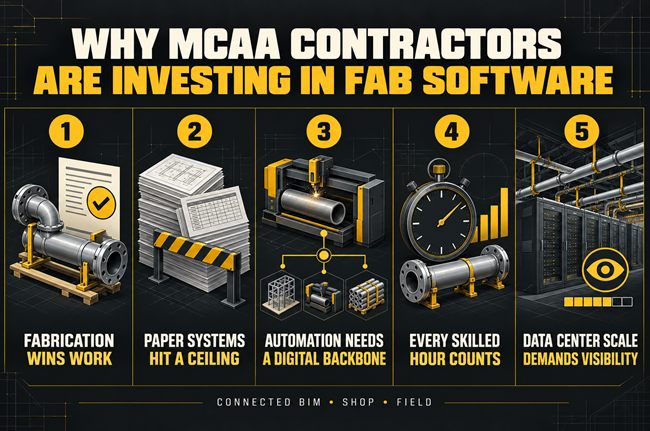
Why are MCAA mechanical contractors investing in dedicated fabrication management platforms?
1. Fabrication is now a requirement to win work
In a 2025 Dodge Construction Network survey of 197 U.S. mechanical contractors, 82% said owners and GCs now require fabrication capability when choosing a mechanical contractor. Once prefab becomes a qualifier, the shop can’t run on guesswork. It has to hit dates the GC is scheduling around.
The same research shows the industry is already moving. 54% of mechanical contractors use fabrication management software today. That includes about three-quarters of large firms ($100M+) and about half of smaller ones.
2. Paper and homegrown systems hit a ceiling
Most shops don’t switch because of a demo. They switch when they can no longer answer a simple question: where is that spool?
AZCO, a Burns & McDonnell company featured in MCAA’s Smart Solutions series, ran its 45,000 sq. ft. pipe fab facility on paper spool drawings, Excel and a homegrown program with no real-time tracking. As project volume grew, leadership couldn’t see true production status. After moving to a dedicated platform, pipe fabrication department manager Matthew Benner said: “My PMs were getting real-time information. I was able to know exactly where the spools were and where they were on the shop floor.”
The Dodge data shows the same direction across the industry: 87% of current users chose a commercial product over a homegrown one.
3. Shop automation needs a digital backbone
CNC profilers, automated saws and robotic welders only pay off when the right data reaches them. In the Winter 2026 Smart Solutions issue, Texas-based Bassett Mechanical, which has an average of 120 fabricators on its floor each day, described linking its design files, CNC cutting equipment and fabrication tracking into one connected workflow.
The result, according to vice president of manufacturing Tyler Peterson: “We’ve reduced the manual processes of administering work: less printing, copying, scanning, and moving documents around the shop. We now have real-time visibility into project status, welder IDs, and heat numbers.” He added that getting every project into one system lets the team “track performance and analyze throughput by drawing, package, and workflow.”
The same issue described Waldinger Corporation reaching 300–345 factored diameter inches (FDI) a day with robotic spool welding, roughly the output of three to four skilled welders. That kind of output needs spool planning and status tracking upstream to keep the robot fed.
4. Every skilled hour has to count
Most contractors can’t hire their way out of the labor shortage. Dodge found the top obstacles to BIM-driven fabrication are people problems: need for training (37%) and lack of skilled expertise (30%), ahead of implementation cost (27%).
Dedicated shop software helps by taking admin work off skilled hands. Fabricators stop hunting for the current drawing or re-keying cut lengths. Foremen stop walking the shop to answer status calls. As Palmer Christiansen’s president put it in the same MCAA issue, “Prefabrication for us is about coordination, not reducing labor.” Good software is how that coordination happens.
5. Data center scale exposes weak visibility
MCAA’s Winter 2026 issue called data centers “one of the largest building surges in modern history,” citing New York Times reporting of $10 billion in U.S. data center construction spending in a single quarter, up 35% from the year before. These jobs bring heavy pipe volumes, tight windows and almost no room for error.
When dozens of packages run at the same time across multiple projects, a whiteboard can’t tell you whether you’ll make Friday’s truck. That’s why Dodge found most fabrication software users want to improve forecasting and process tracking next.
What fabrication shop software are MCAA member contractors adopting?
The platforms MCAA peers describe in Smart Solutions share a common set of capabilities. Use this as a checklist when you evaluate fabrication software:
- BIM-to-shop connection: Spool drawings and assembly packages flow from Revit and fabrication models directly to the shop, with no manual takeoffs.
- Digital drawings on the floor: Every fabricator works from the current revision on a tablet or kiosk, not a stale printout.
- Real-time status by spool, package and project: PMs and the field see progress without phone calls.
- QA/QC traceability: Welder IDs, heat numbers and inspection records are captured as work happens, which makes audits and turnover packages much easier.
- CNC and equipment integration: Cut lists and files export straight to saws, profilers and cutting software.
- Labor and throughput data: Hours by package and workflow feed back into estimates and schedules.
- Fits your existing stack: The platform connects to the project management and ERP tools you already use.
ROI callouts: what the research and peers report
| METRIC | SOURCE |
|
|
|
|
|
|
|
|
|
|
|
|
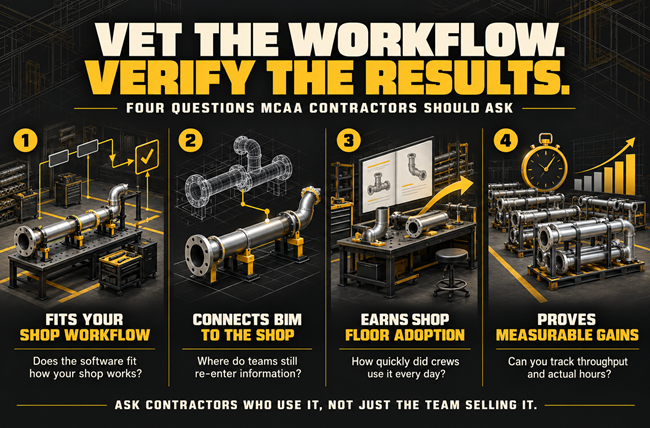
How MCAA contractors vet fabrication software (without trusting the pitch)
The smartest buyers treat software like any major shop investment and check with their peers first. One Smart Solutions headline summed up the mindset: it’s “not just a software purchase but a labor decision.” Before you commit, ask contractors who run it:
- Was it rolled out around how your shop actually works? Or did you have to rebuild your process around the software?
- How seamless is the BIM integration really? Only about half of Dodge respondents say their integration works smoothly.
- How fast did the floor adopt it? Training was the #1 obstacle in the research.
- What can you measure now that you couldn’t before? Look for concrete answers like throughput by package or actual vs. estimated hours.
MCAA events, the MCAA Annual Convention and the Smart Solutions library are good places to have those conversations.
The bottom line
MEP construction is asking more of the fab shop every year: more prefab, tighter schedules and fewer skilled hands. MCAA members who have moved to dedicated fabrication shop software aren’t chasing a trend. They’re replacing paper and spreadsheets with one connected system that shows where every spool is and what it took to build it. Your peers have already done the vetting. Their results are a better guide than any vendor claim.
Frequently Asked Questions (FAQ)
What fabrication shop software are MCAA contractors using?
MCAA members featured in the Smart Solutions case study series are adopting dedicated, commercial fabrication management platforms. These connect BIM models to the shop floor and track spool status, QA/QC data, labor and throughput in real time. Most contractors (87% of current users, per Dodge) choose commercial software over homegrown tools.
Why are mechanical contractors moving away from spreadsheets for fab shop management?
Spreadsheets and paper can’t give real-time status across many concurrent projects. They also can’t capture QA/QC traceability or feed CNC equipment. As prefab volume grows and 82% of owners and GCs require fabrication capability, contractors need live visibility.
How many mechanical contractors use fabrication management software?
54%, according to Dodge Construction Network’s 2025 survey of 197 U.S. mechanical contractors. That’s about three-quarters of large firms and about half of smaller ones.
What should I look for in MEP fabrication software?
Look for a direct BIM-to-shop connection, digital drawings on the floor, real-time status by spool and package, QA/QC traceability (welder IDs, heat numbers), CNC export, labor and throughput reporting, and integration with your project management and ERP systems.
What is the ROI of fabrication shop software?
Contractors report fewer errors, less admin time, real-time production visibility and better planning. Dodge respondents cite improved cost, schedule and quality performance from BIM-driven fabrication, and 73% rate digital fabrication better than site-based work.
MSUITE, part of DEWALT Construction Technology and a proud MCAA Manufacturer/Supplier Council member, helps mechanical contractors connect BIM, fabrication and field data. See how MCAA contractors like Bassett Mechanical and AZCO run their shops →

Sources:
- MCAA, Smart Solutions Case Studies, including “Reducing Fabrication Errors and Increasing Visibility” (AZCO)
- MCAA Smart Solutions, Winter 2026 issue: “Elevating Operations” (Bassett Mechanical), “Boosting Productivity & Quality” (Waldinger Corporation), “Keeping On Track” (Palmer Christiansen Co.), “Contractors Play a Critical Role in Data Center Construction Boom”
- Dodge Construction Network, Optimizing Digital Fabrication for Mechanical Contractors SmartMarket Brief (survey of 197 U.S. mechanical contractors, 2025), download via MSUITE
- DEWALT/MSUITE, How AZCO Brought Real-Time Control to Pipe Fabrication case study (2026)