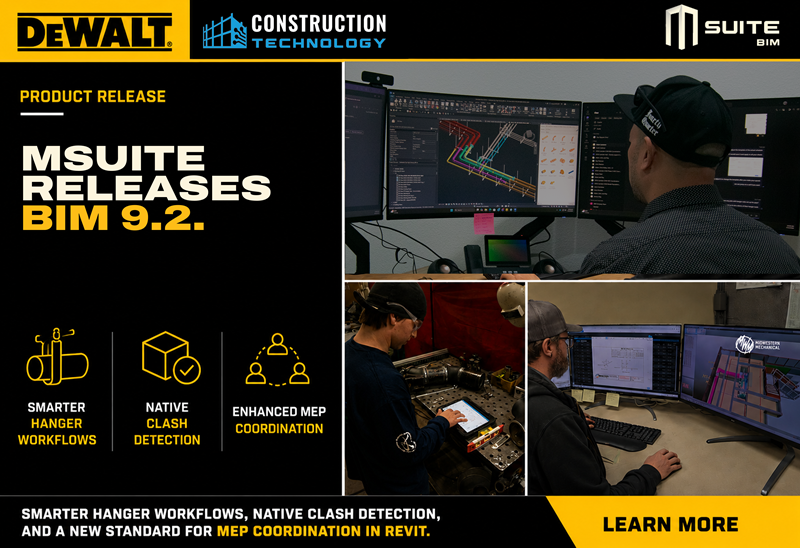
BIM automation is software that handles repetitive detailing tasks like spool creation and hanger placement automatically, letting MEP teams cut spooling time by up to 70% without adding headcount. Leading MEP and Industrial contractors are using BIM software to multiply detailing capacity, accelerate fabrication, and meet growing project demand without proportional increases in labor.
The construction industry is growing faster than its workforce can keep up. Data centers, healthcare facilities, semiconductor plants, and large commercial projects are driving demand for MEP fabrication capacity. At the same time, experienced BIM detailers and VDC professionals remain difficult to recruit and retain. Hiring more people is not a scalable answer.
That is why leading MEP contractors are turning to BIM software automation to multiply what their existing teams can produce. Contractors that automate detailing and spooling workflows are reducing spool creation time by up to 70 percent, increasing fabrication throughput, and improving schedule predictability.
For BIM managers, fabrication leaders, and VDC directors, BIM automation is one of the fastest paths to expanding MEP fabrication capacity.
Why BIM Software Is Now a Fabrication Imperative
The data makes the stakes clear.
A recent Dodge SmartMarket Brief found that 82% of mechanical contractors believe fabrication capability is required to win work. MEP fabrication is now a baseline expectation, not a differentiator.
But fabrication performance does not start on the shop floor. It starts in BIM.
Every spool package, hanger layout, fabrication drawing, and bill of materials begins as a detailing task. When detailing workflows are slow or inconsistent, the downstream operation feels it. Shops sit idle. Material deliveries fall out of sequence. Project schedules compress.
BIM automation eliminates these bottlenecks before they start.
What BIM Automation Actually Does
BIM automation uses software-driven workflows to handle repetitive, rules-based tasks that consume detailing time — such as spool creation, hanger placement, drawing generation, and fabrication exports.
Rather than replacing skilled BIM professionals, automation handles mechanical work, allowing detailers to focus on coordination, constructability, and quality.
Common BIM automation workflows include:
Automated spool creation — Generate fabrication-ready spool packages directly from the model, with standardized naming, sheet layouts, and isometric views
Automated hanger placement — Apply predefined engineering standards to support designs across systems
Fabrication package generation — Produce complete work packages without manual assembly
CNC exports and machine integration — Push cut lists and fabrication data directly to shop equipment
Bill of materials reporting — Automatically generate accurate material takeoffs tied to model data.
The goal is not fewer detailers. The goal is to increase output from every detailer on your team while reducing wasted time on repetitive tasks.
Why Manual Spooling Slows Down MEP Fabrication Capacity
Many contractors still rely on manual spooling processes. A BIM professional may spend hours on a single package, selecting components, creating spool boundaries, generating sheets, producing isometric drawings, managing revision numbering, and exporting fabrication data.
Each of those steps is necessary. None of them creates a competitive advantage.
On complex projects, such as data centers, industrial facilities, and healthcare campuses, manual workloads are difficult to scale. The mismatch between project demand and detailing capacity grows wider every year.
This is the core problem BIM automation solves.
Real Results: MLP Consulting Cuts Spool Creation Time by 74%
The numbers are not theoretical.
MLP Consulting deployed MSUITE BIM to automate its spooling workflows, reducing spool creation time by approximately 74%. The impact extended beyond the detailing team.
Faster spool generation means fabrication shops can begin production sooner. Material flow improves. Labor utilization increases. Project schedules become more predictable.
This is the key insight most contractors miss when evaluating BIM software: reducing spooling time is not just a BIM efficiency metric. It is a business metric. Every hour saved in detailing creates gains throughout MEP fabrication and installation.
BIM Automation Multiplies Workforce Capacity — It Does Not Replace It
One of the most persistent misconceptions about BIM automation is that it displaces jobs.
In practice, it does the opposite. Automation lets experienced BIM professionals focus on work that requires human judgment, such as coordination, clash resolution, fabrication planning, schedule management, and field support. Software handles the repetitive mechanics. A detailing team that previously produced 100 spool packages per week may produce 150, 170, or more with fewer errors. That added capacity is valuable when experienced BIM talent is scarce, and project pipelines are expanding.
According to FMI research, improving construction labor productivity represents a multi-billion-dollar opportunity for the industry. BIM automation is one of the few scalable ways contractors can capture that opportunity without proportional increases in labor cost.
From BIM to Fabrication: The Compounding Effect
The downstream benefits of faster, more accurate BIM automation compound throughout the project lifecycle:
Shops begin production sooner — Fabrication packages arrive earlier, keeping machines running and crews productive.
Material flow improves — Accurate, timely BOMs prevent over- and under-ordering and costly delays.
Rework decreases — Standardized, automated processes reduce errors that lead to costly field corrections.
Schedule predictability increases — When detailing and fabrication stay in sync, project timelines are easier to protect
For MEP fabrication leaders, this is the real case for BIM automation: it is not just a detailing tool. It is an operational strategy that helps teams scale output while protecting schedules.
Frequently Asked Questions
What is BIM automation?
BIM automation uses software-driven workflows to handle repetitive modeling, detailing, coordination, and fabrication preparation tasks, freeing BIM professionals to focus on higher-value work.
How much time can BIM automation save on spooling?
Results vary by operation and complexity, but contractors commonly report productivity improvements ranging from 30% to more than 70%. MLP Consulting reduced spool creation time by 74% using MSUITE BIM.
What is automated spooling?
Automated spooling uses predefined rules and software workflows to generate complete, fabrication-ready spool packages directly from BIM models, without manual drawing setup, sheet generation, or export configuration.
Does BIM automation reduce labor requirements?
BIM automation typically increases labor productivity rather than reducing headcount. Contractors use it to expand output and increase capacity with their existing teams.
How does BIM automation help fabrication shops?
Faster spool generation allows fabrication shops to begin production sooner, improve throughput, reduce bottlenecks, and maintain more predictable delivery schedules.
Is BIM automation only useful for large contractors?
No. Contractors of all sizes benefit from automation. Smaller teams often see the most dramatic gains because automation makes a lean detailing team capable of competing with larger operations.
The Future of MEP Fabrication Runs Through BIM Automation
Labor constraints are not going away. Project complexity is not decreasing. Contractors that grow in this environment will be the ones that offer more than simply hiring more detailers.
They will be the ones who enable their teams to produce more.
MSUITE BIM helps MEP contractors automate spool creation, streamline hanger workflows, accelerate fabrication readiness, and improve coordination across BIM, FAB, and FIELD. The result is faster detailing, higher fabrication throughput, and an operation that can scale to meet the demands of today’s construction market.