
The 2027 MEP fabrication market will be shaped by three forces: data center spending that keeps growing while most other commercial work stays flat, a craft labor gap driven mainly by retirements, and AI tools that only pay off when shop data is clean. U.S. forecasts point to modest overall growth in 2027, with most of the upside concentrated in a few sectors. For mechanical, plumbing, and electrical contractors, that means more of each job will move into the shop, and owners will judge MEP partners on how predictably that shop delivers.
Below is what the latest U.S. data says, and what it means for contractors planning next year’s fabrication capacity.
What are the MEP fabrication industry trends for 2027?
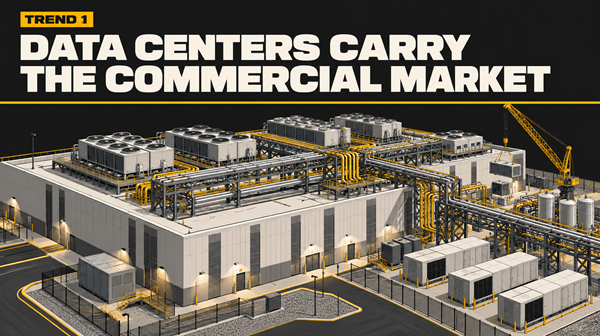
Trend 1: Data Centers Carry the Commercial Market
The AIA Consensus Construction Forecast from July 2026 projects data center spending to rise 33 percent in 2026 and about 25 percent in 2027. Strip data centers out, and commercial construction is roughly flat: down about 1 percent in 2026 and up about 1 percent in 2027. Overall nonresidential building spending is forecast to dip 0.3 percent this year before growing 3 percent in 2027.
Planning data tells the same story. The Dodge Momentum Index for September 2026 showed that, excluding data centers, commercial planning would have been down 14.9 percent from a year earlier. Contractors feel it too. In the AGC 2026 Construction Hiring and Business Outlook, data centers posted the strongest net reading of any market at 57 percent, with power projects second at 34 percent.
Data center work suits prefabrication. Mechanical rooms, piping, and electrical distribution repeat across halls and buildings, and schedules leave little room for field fabrication. “For repetitive, high-volume projects such as data centers, MSUITE helps us track multiple activities at once,” said Bill Tunberg, Superintendent at F.E. Moran.
Data center spending: +33% in 2026, +25% in 2027. Commercial construction without data centers: roughly flat. (AIA Consensus Construction Forecast, July 2026)
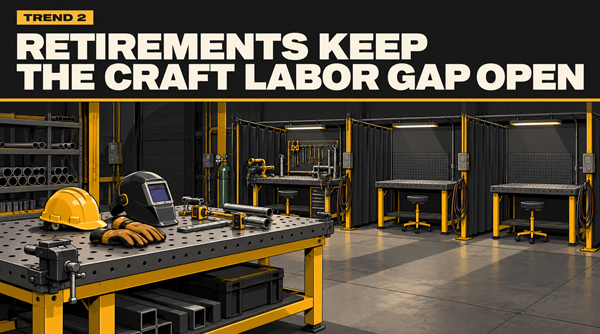
Trend 2: Retirements Keep the Craft Labor Gap Open
Associated Builders and Contractors estimates the industry must attract 349,000 net new workers in 2026 and 456,000 in 2027. ABC’s chief economist attributes most of the 2026 need to retirements rather than new demand, which means the gap persists even when spending is soft.
The 2026 AGC and NCCER Workforce Survey, conducted in July and August 2026, found that 87 percent of firms have open hourly craft positions. Electricians were the hardest craft to fill, cited by 81 percent of firms hiring for them, and about three-quarters of firms hiring plumbers reported difficulty. Forty-two percent said labor shortages, their own or their subcontractors’, had delayed projects.
Prefabrication is the main lever MEP contractors have against that gap. FMI’s 2024 labor productivity research found contractors run 16 to 18 percent of craft hours through prefabricated assemblies and expect that share to reach 34 percent within five years. A fitter in a shop with good material flow and clear work packages produces more than the same fitter on a congested deck.
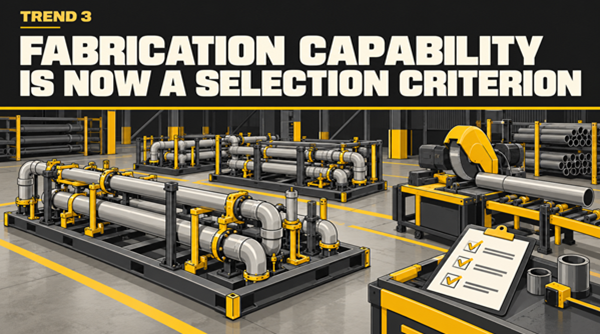
Trend 3: Fabrication Capability Is Now a Selection Criterion
The Dodge Construction Network SmartMarket Brief on digital fabrication, based on a survey of 197 U.S. mechanical contractors, found that 82 percent say owners and GCs require fabrication capability when selecting a mechanical contractor.
The same research shows how uneven that capability still is:
- 54 percent of mechanical contractors use fabrication management software.
- 86 percent have integrated BIM with fabrication software, but only half say the integration works seamlessly or very well.
- 67 percent of large contractors fabricate on half or more of their projects, compared with 26 percent of small firms.
For 2027, the gap between contractors who can show a GC real-time spool status and those who cannot will matter more in prequalification. Owners on data center and healthcare work increasingly expect schedule evidence, not schedule promises.

Trend 4: AI Moves From Curiosity to Workflow
The AGC outlook found 61 percent of firms either use AI or plan to increase their investment in it, up from 44 percent a year earlier. Dodge reports that about half of mechanical contractors use AI now, mostly for design optimization, analysis, and estimating, and that 25 percent use AI-assisted design specifically.
The catch is data. AI estimating and scheduling tools learn from historical production records, and many fab shops still track labor and spool status in spreadsheets or on paper. Shops that capture labor hours, weights, and cycle times per spool in 2026 will have something useful to feed AI in 2027. Shops that do not will be training tools on guesses.
61% of U.S. contractors now use AI or plan to increase AI investment, up from 44% a year earlier. (AGC, 2026)
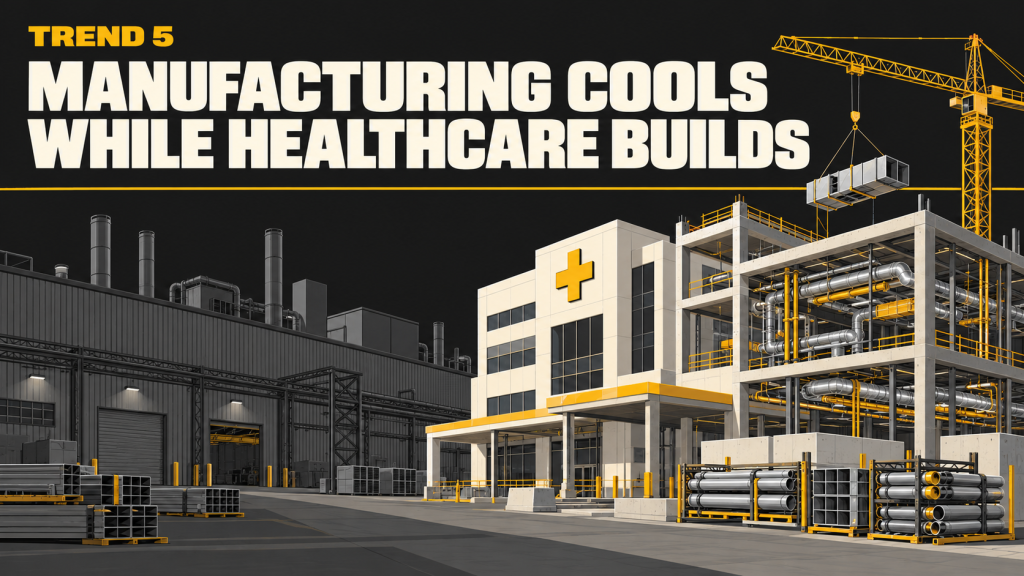
Trend 5: Manufacturing Cools While Healthcare Builds
Not every sector is growing. AIA forecasts manufacturing construction spending down 11.6 percent in 2026 and another 0.6 percent in 2027 as the post-2022 factory boom winds down. Healthcare moves the other way, with spending forecast up 2.6 percent in 2026 and 4.4 percent in 2027. Dodge reported institutional planning up 17.2 percent year over year in September, led by education, healthcare, and government buildings.
Dodge’s director of economic research, Sarah Martin, said nonresidential sectors “should see a marginally stronger late 2027” as steady growth resumes. For fab shops heavy in industrial or manufacturing backlog, healthcare and institutional work offer a hedge. Both reward the same prefab strengths: corridor racks, headwall assemblies, and repeatable plumbing carriers.
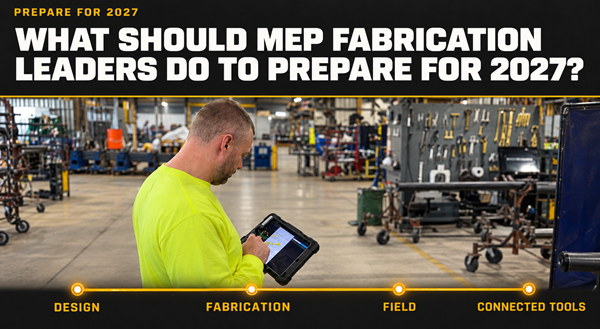
What Should MEP Fabrication Leaders Do to Prepare for 2027?
- Plan capacity by sector, not by total backlog. Data center and healthcare packages need different assembly mixes. Forecast shop hours by assembly type so you hire, buy equipment, and lay out stations for the work that is actually coming.
- Connect BIM, fabrication, and field on one platform. With only half of contractors satisfied with their BIM-to-fab integration, a single connected workflow is a competitive edge in GC selection. MSUITE, a cloud platform from DEWALT Construction Technology, connecting BIM, FAB, and FIELD for MEP and industrial fabrication, is built for that handoff.
- Start capturing production data now. Labor hours, weights, and cycle times by spool become the training data for AI estimating and the evidence for future bids.
- Make the shop the place new hires learn. A controlled environment with clear work packages shortens the ramp for apprentices, which matters when retirements drive most of the hiring need.
F.E. Moran’s experience shows why the connected workflow matters as volume grows. “As the company grows and the workload increases, the number of spools we have to create also increases. MSUITE has enabled us to meet that demand,” said Joe Beatty, Director of BIM Operations at F.E. Moran.
Frequently Asked Questions
What are the MEP fabrication industry trends for 2027?
- The main 2027 trends are continued data center growth (forecast at about 25 percent), a craft labor gap of roughly 456,000 workers driven largely by retirements, a rising share of craft hours moving into prefabrication, owners and GCs requiring fabrication capability during contractor selection, and wider AI adoption for estimating and design.
How will labor shortages and AI infrastructure demand shape MEP prefabrication in 2027?
- Labor shortages push more work off the jobsite and into fabrication shops, where fewer workers can produce more. AI infrastructure demand, mainly data centers, supplies the repetitive, schedule-critical work that prefabrication handles best. Together they increase both the volume and the speed expected from MEP fab shops.
Is modular construction growing for MEP contractors?
- Yes, mostly in the form of multi-trade racks, skids, and repeatable assemblies rather than full volumetric modules. Dodge found that 77 percent of U.S. mechanical contractors already do some multi-trade fabrication, and data center and healthcare projects are expanding demand for it.
Which construction sectors will grow in 2027?
- AIA’s July 2026 forecast projects the strongest 2027 growth in data centers (about 25 percent), healthcare (4.4 percent), and hotels (5.2 percent). Manufacturing is forecast to decline slightly after a steep 2026 drop.
Plan Your 2027 Fabrication Capacity
If your shop is preparing for more data center, healthcare, or industrial volume next year, schedule an MSUITE demo to see how contractors connect BIM, fabrication, and the field to deliver more with the crews they have.
Sources
- AIA Consensus Construction Forecast, July 2026
- Dodge Construction Network: Dodge Momentum Index, September 2026
- Dodge Construction Network: Optimizing Digital Fabrication for Mechanical Contractors SmartMarket Brief
- AGC: 2026 Construction Hiring and Business Outlook
- AGC and NCCER: 2026 Workforce Survey Analysis
- Associated Builders and Contractors: 2026 Workforce Shortage Analysis
- FMI 2024 Labor Productivity Study, via MSUITE
- E. Moran customer video