
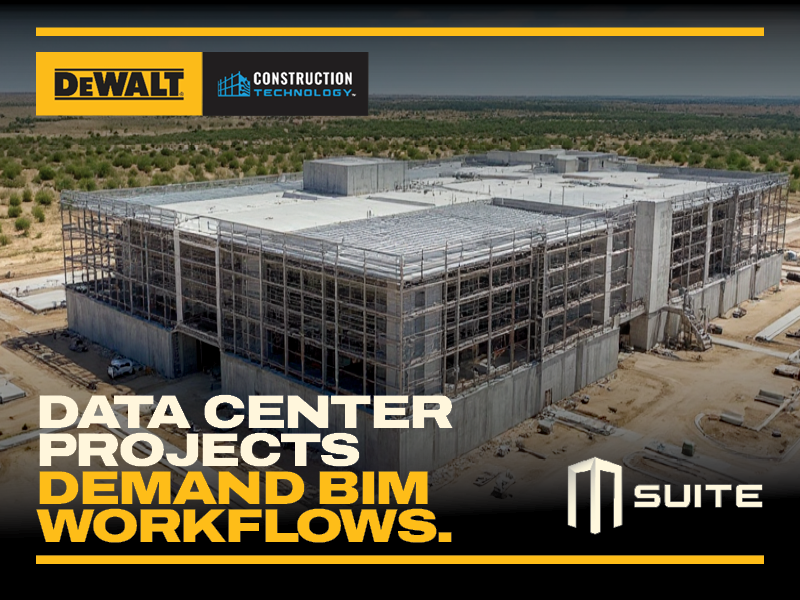
The data center construction boom is rewriting the rules. Data center construction has moved from a niche market to one of the fastest-growing segments in commercial construction. Hyperscalers, colocation providers, and enterprise operators are racing to expand capacity to support AI workloads, cloud services, and edge computing. According to McKinsey, global demand for data centers could grow at more than 10 percent annually through the next decade, driven largely by AI and high-density compute requirements.
This growth brings a hard reality: data center schedules are unforgiving. Owners expect accelerated delivery, repeatable execution, and near-zero tolerance for rework. Traditional BIM workflows that stop at coordination or clash detection no longer meet the demands of modern data center projects.
For contractors, success increasingly depends on fabrication-driven BIM workflows that connect modeling directly to spooling, hanger placement, and shop production.
Fabrication-Driven BIM Explained
Fabrication-driven BIM connects design modeling directly to fabrication and field execution. Instead of stopping at coordination, the model drives spooling, hanger placement, material planning, and installation sequencing. This approach reduces rework, accelerates schedules, and improves consistency across data center projects.
What is fabrication-driven BIM for data centers?
Fabrication-driven BIM is an approach in which BIM models are created to fabrication tolerances and used directly to generate spools, hanger layouts, and shop deliverables, ensuring that what is modeled is exactly what gets built and installed.
Why traditional BIM breaks down on data center projects
Data centers push MEP systems harder than almost any other building type. Dense routing, redundant systems, strict clearances, and massive hanger counts create conditions where small modeling gaps turn into major field delays.
Common issues include:
- BIM models that look coordinated but are not fabrication-ready
- Manual spooling processes that slow down shop throughput
- Hanger layouts created late or outside the model
- Disconnects between BIM teams and fabrication shops
- Limited visibility into production status once spools hit the shop floor
Autodesk research shows that rework remains one of the biggest productivity drains in construction, often accounting for more than 5 percent of total project cost.
On data center projects, rework compounds quickly. Missed hanger locations, late spools, or incomplete assemblies can ripple across entire rooms or levels.
Fabrication-driven BIM changes the delivery model
Fabrication-driven BIM flips the traditional approach. Instead of treating BIM as a design or coordination deliverable, it becomes the production engine that drives shop and field execution.
In a fabrication-driven workflow:
- BIM models are built to fabrication tolerances
- Spools are generated directly from the model
- Hangers are placed early and automatically
- Shop production aligns to model data
- Field installation follows fabrication intent
This approach ensures consistency between what is modeled, fabricated, and installed. It also allows teams to scale production without scaling headcount.
MSUITE was built specifically to support this shift, connecting BIM, fabrication, and field workflows into a single platform.
Why hanger placement is a critical bottleneck in data centers
Hangers are one of the most underestimated drivers of labor and schedule risk on data center projects. A single data hall can require tens of thousands of hangers, each requiring consideration of load, clearance, coordination, and constructability.
When hanger layouts are created manually or outside the BIM model, problems emerge:
- Late design changes force field rework
- Fabrication teams lack a clear installation intent
- Field crews make judgment calls under schedule pressure
- Inspection and approval cycles slow down
Fabrication-driven hanger automation solves this problem by placing hangers directly in the model, aligned with spools and assemblies. MSUITE Hangers automates hanger layout inside BIM workflows, allowing teams to generate consistent, code-compliant hanger designs early in the project lifecycle.
For data center contractors, this reduces field labor risk while improving predictability.
Structured fabrication data unlocks future intelligence
Modern data center projects generate massive volumes of information, but only structured data creates long-term value. When BIM, fabrication, and field data live in disconnected systems, contractors lose the ability to learn from past projects.
MSUITE structures fabrication data across BIM, shop, and field workflows so contractors can leverage AI for predictive insights and decision-making. This matters because AI depends on clean, connected data, not PDFs or spreadsheets.
As data center programs expand, contractors who can analyze production rates, installation patterns, and bottlenecks gain a competitive advantage.
The future of data center fabrication is connected
Data center construction will only grow more complex as AI, cooling innovation, and density requirements evolve. Contractors who rely on disconnected BIM and fabrication processes will struggle to keep pace.
Fabrication-driven BIM is no longer optional. It is the foundation for delivering modern data centers on time and at scale.
MSUITE helps contractors close the gap between BIM, fabrication, and field execution by providing a connected platform built for the realities of high-volume, high-precision projects. See MSUITE today.
Frequently Asked Questions About Data Centers and Fabrication
Why is fabrication critical for data center construction?
Fabrication is critical for data center construction because dense MEP systems, tight tolerances, and aggressive schedules leave little room for field improvisation. Fabrication ensures assemblies are built accurately, installed faster, and coordinated before reaching the jobsite.
How does BIM improve data center fabrication?
BIM improves data center fabrication by enabling contractors to generate spools, hanger layouts, and installation-ready assemblies directly from the model. When BIM is connected to fabrication workflows, it reduces manual effort, improves accuracy, and increases shop throughput.
What causes rework on data center MEP projects?
Rework on data center MEP projects is often caused by late hanger coordination, incomplete fabrication details, disconnected BIM and shop workflows, and poor visibility into production status. Fabrication-driven BIM addresses these issues early in the project lifecycle.
How does hanger automation help data center projects?
Hanger automation helps data center projects by placing hangers directly in the BIM model based on load, clearance, and coordination rules. This reduces field layout labor, minimizes inspection issues, and ensures consistency across large-scale installations.
What software supports fabrication-driven BIM for data centers?
Platforms like MSUITE support fabrication-driven BIM by connecting BIM modeling, automated spooling, hanger placement, and fabrication tracking into one system designed for MEP and industrial contractors.