
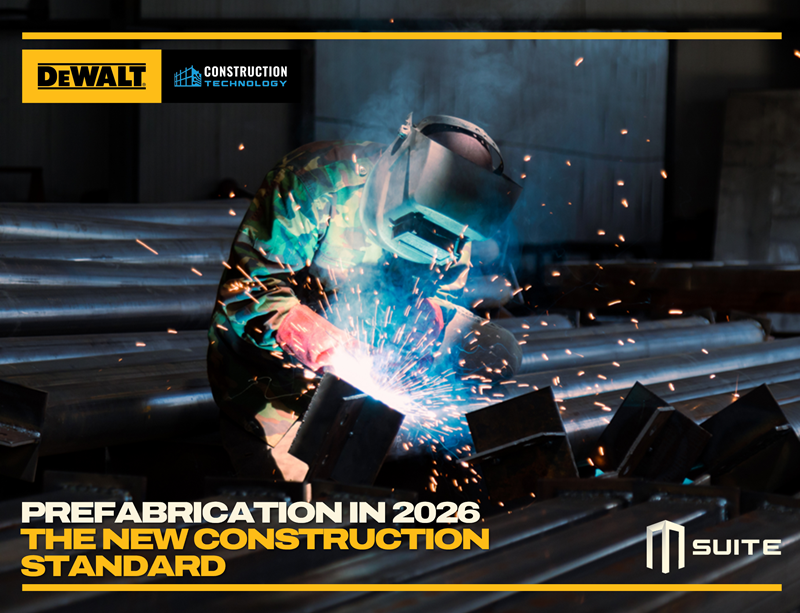
Construction is entering a decisive decade. In 2026, prefabrication is no longer an emerging trend or a niche strategy reserved for advanced contractors. It is becoming the default operating model for firms that need to deliver faster, control labor, and meet owner expectations for certainty.
Rising labor costs, skilled workforce shortages, tighter schedules, and margin pressure have forced contractors to rethink how work gets built. Prefabrication answers that challenge by shifting construction from reactive, site-based work to controlled, repeatable production environments.
This guide explores why prefabrication matters more than ever in 2026, the tangible benefits contractors are realizing today, and why success increasingly depends on a single source of truth that connects BIM, fabrication, and field execution.
Why prefabrication is accelerating in 2026 and macro forces converging at once, pushing the industry toward offsite construction.
1. Labor Shortages Are Structural, Not Temporary
- Construction continues to face a long-term skilled labor gap. Autodesk research shows that workforce constraints remain one of the top risks to project delivery across North America.
- Prefabrication reduces reliance on scarce field labor by shifting work into repeatable shop processes where fewer people can produce more output with greater consistency.
2. Owners Demand Schedule Certainty
- In sectors like data centers, healthcare, and advanced manufacturing, owners are no longer tolerant of schedule drift. Prefabrication enables parallel workstreams. While site work progresses, assemblies are built, tested, and staged offsite.
3. Margins Leave No Room for Rework
- McKinsey research highlights how fragmented workflows and rework continue to erode productivity across construction.
- Prefabrication reduces variability, which directly reduces costly downstream fixes.
What Prefabrication Actually Means in 2026 Construction
Modern prefabrication goes far beyond assembling duct or pipe racks in a warehouse.
In 2026, leading contractors apply prefabrication across:
- MEP multi-trade racks
- Skidded mechanical systems
- Electrical assemblies
- Modular wall systems
- Equipment supports and hangers
The defining difference is not what gets prefabricated, but how it is managed. Successful prefabrication relies on precise planning, repeatable processes, and accurate data flowing from design through fabrication and into installation.
The Core Benefits of Prefabrication
1. Labor Productivity and Predictability
- Fabrication shops operate in controlled environments. Weather, congestion, and access constraints disappear. Tasks become repeatable, measurable, and easier to train.
- The FMI Construction Labor Productivity report estimates that inefficiency costs the industry billions annually. Prefabrication directly solves this problem by standardizing work.
2. Schedule Compression
- Prefabrication enables true parallelization. While foundations and structures are advanced onsite, assemblies are built offsite. Install crews can now focus on placement rather than fabrication, accelerating overall delivery.
3. Quality Control
- Shop-built assemblies undergo inspection and testing before reaching the site. That dramatically reduces punch lists, callbacks, and warranty risk.
4. Improved Safety
- Controlled shop environments lower exposure to fall risks, congestion, and weather-related hazards. Fewer hours on-site translate into fewer incidents.
Why Prefabrication Fails Without the Right Foundation
Despite its benefits, many contractors struggle to scale prefabrication. The root cause is rarely the shop itself. It is the lack of connected workflows and data.
Common failure points include:
- BIM models disconnected from fabrication planning
- Spreadsheets for managing production status
- Inconsistent naming and revision control
- Poor visibility into what is ready, in progress, or delayed
When prefabrication is managed with fragmented tools, the shop becomes a bottleneck instead of an accelerator.
The Critical Role of BIM in Prefabrication
Prefabrication only works when BIM models are fabrication-ready. That means:
- Accurate geometry
- Coordinated supports and clearances
- Logical segmentation for spools or assemblies
- Data structured for production, not just visualization
Coordination-only BIM stops short of delivering these outcomes. Prefabrication demands BIM workflows that extend beyond design coordination and directly support advanced spooling and production planning.
The Need for a Single Source of Truth
By 2026, the most successful prefabrication programs share one common trait: a single system that connects BIM, fabrication, and field execution.
A single source of truth ensures:
- Everyone works from the same, current information
- Changes propagate forward instead of breaking workflows
- Production status is visible without manual updates
- Field teams receive install-ready deliverables
Without this foundation, prefabrication introduces as much risk as it removes.
How Leading Contractors Run Prefabrication at Scale
Advanced contractors increasingly centralize fabrication operations around connected platforms rather than point solutions.
This approach allows them to:
- Drive spooling and assemblies directly from BIM
- Track production by spool, assembly, or zone
- Align fabrication output with install sequencing
- Capture structured data for future optimization
Platforms like MSUITE, part of DEWALT Construction Technology, are designed around this single-source-of-truth model. Rather than forcing teams to stitch together disconnected tools, they centralize BIM, fabrication workflows, and production tracking in one environment. The value is not just speed. It is confidence in the output.
Prefabrication data is the Foundation for AI and Automation
- As contractors look toward AI-driven planning, predictive scheduling, and automated fabrication, prefabrication becomes even more critical.
- AI depends on structured, connected data. Prefabrication shops generate enormous volumes of production data, but only when that data is centralized and standardized can it be used for forecasting, benchmarking, or optimization.
- Running prefabrication from a single source of truth positions contractors to move beyond reactive management toward predictive control.
Prefabrication in 2026 Is a Business Strategy
Prefabrication is no longer a shop-level experiment. In 2026, it is a core business strategy that influences:
- How projects are bid
- How labor is allocated
- How schedules are committed
- How margins are protected
Contractors that treat prefabrication as a side initiative struggle to scale it. Those that build their operations around it gain a structural advantage.
Final Takeaway
Prefabrication is reshaping construction in 2026 because it aligns with the realities contractors face: labor constraints, compressed schedules, and margin pressure. The benefits are clear: faster delivery, better quality, improved safety, and greater predictability. But those benefits only materialize when prefabrication is supported by connected BIM workflows and a single source of truth for running the fabrication shop.
As the industry continues its shift toward industrialized construction, contractors that invest in prefabrication, supported by platforms like MSUITE within the DEWALT Construction Technology ecosystem, will be positioned not just to keep up, but to lead.
Prefabrication is no longer the future of construction. It is the standard being set right now. See MSUITE today.