
Introduction
MEP fabrication has moved from a competitive advantage to a baseline requirement for mechanical contractors.
As project schedules tighten and labor becomes harder to secure, contractors are under pressure to deliver more work with fewer resources. Traditional field-built approaches cannot keep up with those demands. Fabrication changes the equation.
By shifting work off the jobsite and into a controlled shop environment, MEP fabrication allows contractors to standardize production, reduce variability, and accelerate installation timelines. But fabrication alone does not guarantee results. The contractors seeing the biggest gains are not just fabricating more. They are connecting design, production, and field execution into a single workflow. This article breaks down what MEP fabrication involves, why adoption is accelerating, and what it takes to scale fabrication operations successfully in 2026.
What Is MEP Fabrication?
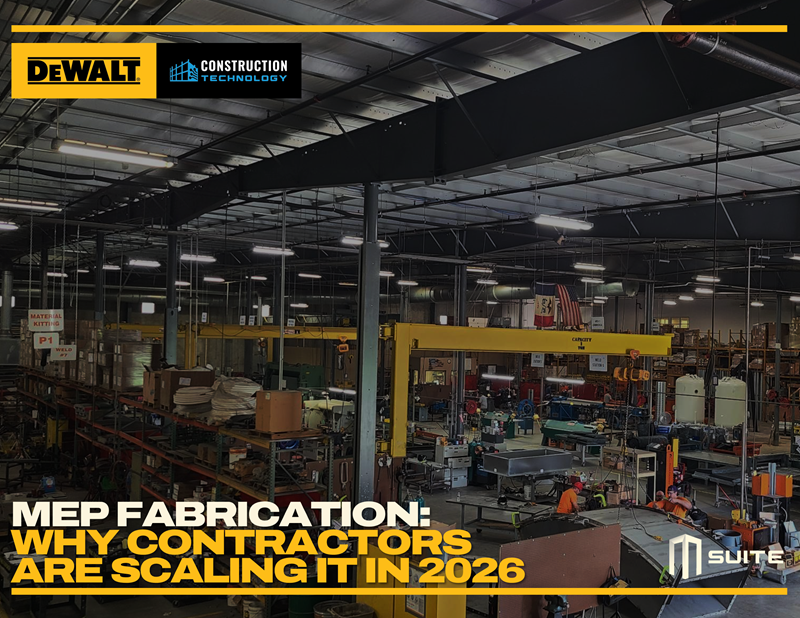
MEP fabrication is the process of manufacturing mechanical, electrical, and plumbing systems in a controlled shop before delivering them to the jobsite for installation.
Instead of assembling piping systems, ductwork, and electrical infrastructure in the field, contractors build these systems in advance using precise design inputs and repeatable production workflows.
Common examples of MEP fabrication include:
- Pipe spool fabrication built to isometric drawings
- HVAC ductwork formed and assembled from sheet metal
- Multi-trade racks combining pipe, conduit, and duct
- Plumbing assemblies such as risers and bathroom groups
- Electrical assemblies including conduit runs and panel builds
The defining characteristic of MEP fabrication is control. Work performed in a shop environment is easier to plan, easier to execute, and easier to measure than work performed in the field.
Why MEP Fabrication Is Expanding in 2026
The growth of MEP fabrication is not driven by preference. It is driven by necessity.
Labor Constraints Are Reshaping Construction
The construction workforce continues to tighten, with contractors competing for a shrinking pool of skilled labor. Hiring alone cannot close the gap between demand and available workers. Fabrication in shop environments allow contractors to increase output per worker. Tasks that require high levels of field experience can be broken into repeatable shop processes that less specialized workers can execute efficiently. This shift does not eliminate the need for skilled labor. It makes better use of it.
Owners and GCs Expect Fabrication Capability
Fabrication is increasingly part of the selection criteria for MEP contractors. Owners and general contractors prioritize partners who can reduce schedule risk and deliver predictable outcomes. Fabrication supports both. Contractors without a clear fabrication strategy are often filtered out early in the procurement process.
Schedule Pressure Is Driving Parallel Workflows
Traditional construction follows a sequence. One trade finishes before another begins. Fabrication breaks that sequence. While structural work progresses on-site, fabrication shops build assemblies simultaneously. This parallel workflow reduces total project duration and creates more flexibility in project execution.
What Happens Inside a Modern MEP Fabrication Shop?
Fabrication is not just about building components early. It is about running a production system.
- Design and Spooling | Every fabrication workflow starts with design. In modern operations, BIM models drive spool creation, cut lists, and material requirements automatically. This eliminates manual translation and reduces the risk of errors. Without a strong BIM-to-fabrication connection, shops rely on manual processes that slow production and introduce inconsistencies.
- Production and Assembly | Fabrication shops operate with defined workflows. Pipe is cut, fit, and welded according to specifications. Ductwork is formed and assembled in repeatable processes. Multi-trade assemblies are built in structured sequences. The focus is throughput. Shops are measured on how efficiently they move work through each stage of production.
- Quality Control and Documentation | Fabrication increases the importance of documentation. Weld logs, inspection records, material traceability, and QA/QC checkpoints must be captured for each assembly. On many projects, these records are required for project closeout. Manual documentation creates bottlenecks. Automated systems ensure documentation is captured as work progresses.
- Delivery and Installation | Finished assemblies are delivered to the jobsite ready for installation. This reduces field labor requirements, shortens installation time, and minimizes rework. Field teams focus on placing and connecting systems, not building them.
Where Fabrication Operations Break Down
The benefits of MEP fabrication are clear. The execution is where most contractors struggle.
Common breakdowns include:
- Disconnected BIM and shop workflows
- Limited visibility into production status
- Manual tracking of spools and assemblies
- Delays in communicating design changes
- Incomplete or inconsistent QA documentation
These issues reduce the effectiveness of fabrication and create new coordination challenges.
Fabrication without visibility is difficult to scale.
Why MEP Fabrication Software Is Required
To scale fabrication operations, contractors need more than tools. They need connected workflows.
MEP fabrication software solves three critical problems.
Connecting Design to Production
- Design changes must reach the shop floor immediately. Without integration, teams rely on emails, PDFs, and manual updates. This creates version control issues and increases the risk of fabrication errors.
Providing Real-Time Production Visibility
- Contractors need to know where every spool and assembly is in the production process. Real-time tracking allows project teams to identify delays early, adjust schedules, and keep field work aligned with fabrication output.
Automating QA and Documentation
- Documentation requirements continue to increase. Software that captures weld logs, inspections, and QA records automatically eliminates the need for manual compilation at the end of a project.
How MSUITE Enables Scalable Fabrication
MSUITE was built specifically to connect BIM, fabrication, and field workflows.
- MSUITE BIM automates design-to-fabrication processes directly inside Revit. Spool creation, hanger placement, and drawing generation happen faster and with greater consistency.
- MSUITE Hangers automates support system layout directly inside the BIM model. Hanger placement updates in real time as the model changes, eliminating manual coordination and rework. Teams can standardize layouts, generate accurate bills of material, and push hanger data downstream to fabrication and installation without extra steps.
- MSUITE FAB tracks production in real time. Each spool moves through defined stages, with status updates, weld tracking, and QA documentation captured automatically. Project teams can see exactly what is complete, what is in progress, and what is ready for installation.
The Result
Contractors using connected workflows gain:
- Real-time visibility across fabrication operations
- Improved shop throughput and production efficiency
- Reduced rework and coordination errors
- Complete turnover documentation at project delivery
Fabrication becomes predictable, measurable, and scalable.
The Future of MEP Fabrication
MEP fabrication will continue to expand as contractors face increasing pressure to deliver faster and more efficiently.
The next phase of fabrication will be defined by:
- Fully connected BIM-to-fabrication workflows
- Real-time production analytics and dashboards
- Increased use of automation and robotics
- Greater reliance on structured fabrication data
Contractors who invest in these capabilities now will be positioned to scale. Those who rely on manual processes will struggle to meet evolving project demands.