
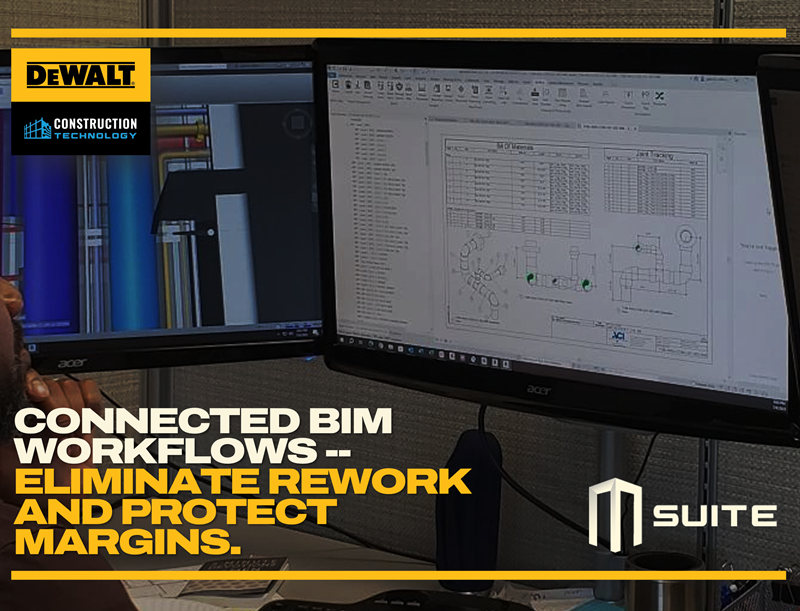
Rework continues to erode profitability across the construction industry. Multiple studies show that rework consumes up to 10 percent of total project cost. In some cases, the number is significantly higher when you consider labor redeployment, material waste, and schedule disruption. Verified research confirms that rework expenses often stem from preventable coordination issues. For example, PlanRadar reports that rework remains one of the most common drains on project budgets and schedules.
Another analysis from Visibuild highlights the true cost of rework by showing how errors compound through labor inefficiencies, lost time, and administrative overhead.
Contractors working in mechanical, electrical, and plumbing trades feel this pressure more acutely. These trades manage complex systems, require precise coordination, and often rely on fabrication and field teams that need perfect alignment. Any error or omission in the model or workflow leads to costly rework. Eliminating rework rests on the strength of a connected workflow that ties design, fabrication, and field installation into a single environment.
A connected BIM workflow provides that environment. It links teams, drawings, fabrication outputs, and field verification through a shared source of truth. Contractors that embrace connected BIM workflows reduce errors, protect margins, and increase productivity. This article explains how connected BIM workflows operate, why they eliminate rework, and how MSUITE structures fabrication operations data so contractors can use AI for predictive insights across BIM, shop, and field.
Why Rework Happens and Why It Persists
Rework stems from design misalignment, incomplete coordination, data silos, and lack of version control. A common industry challenge comes from design errors or omissions that remain undetected until the field discovers them. provides a breakdown of how early design problems lead directly to jobsite rework:
Coordination failures between mechanical, electrical, plumbing, and hanger systems are a leading cause of construction rework. When teams rely on outdated drawings, isolated discipline-specific documentation or poor communication instead of a shared, real-time model, clashes get discovered too late, often only once crews are in the field. Multiple industry reports confirm that poor communication and sub-optimal data quality account for a large portion of rework on construction projects.
Data silos create further complexity. Many teams still work with separate systems for design, fabrication, procurement, and field reporting. A global survey conducted by buildingSMART confirms that more than half of respondents lack fully integrated BIM workflows, leading to gaps that drive rework.
These issues all stem from disconnected workflows. A connected BIM workflow removes these barriers by providing one verified environment where all teams operate from the same information.
What Connected BIM Workflows Look Like
A connected BIM workflow is more than a digital model. It becomes a unified process where design intent flows directly into fabrication and field installation. The workflow includes these core stages:
1. Coordination and Clash Avoidance
When teams share a coordinated BIM model through Procore, they catch clashes long before fabrication or installation. Procore says its BIM tools allow all trades to view the same 3D model, spot spatial conflicts, and flag coordination issues early — which reduces installation errors, improves collaboration, and cuts down on costly rework.
2. Fabrication Planning from the Model
Instead of recreating drawings, fabrication teams generate spools, isometrics, BOMs, and hanger layouts directly from the coordinated model. This reduces manual effort and prevents discrepancies between what was planned and what gets built.
3. Structured Data for Downstream Workflows
BIM metadata such as part identification, spool naming, fabrication status, delivery status, and installation location is captured and structured. This structure becomes the backbone of downstream automation and future AI.
4. Field Installation with Verification
Field teams access installation drawings, hanger layouts, updates, and fabrication status from the same connected environment. Installers confirm that real-world conditions match the model and create immediate feedback loops when deviations occur.
5. Closed Loop Improvement
Completed work, deviations, changes, and field updates return to BIM. Contractors then use this information to improve future coordination, optimize fabrication planning, and prepare for predictive analytics. A connected workflow accelerates each improvement cycle.
Benefits Contractors Gain from Connected BIM Workflows
Reduced Rework and Protected Margins
Rework often accounts for 5 percent to 10 percent of project cost according to analysis from The Access Group: Connected BIM workflows reduce the need to redo work, reschedule crews, or replace components. Teams work from one model and eliminate many causes of waste.
Higher Labor Productivity
Research from building SMART shows that 71 percent of firms using BIM report better decision making, while 65 percent report faster identification and resolution of issues. One shared source of truth improves productivity across modeling, fabrication, and installation.
Improved Material Planning and Less Waste
Autodesk documents how BIM supports more efficient material planning, reduces waste, and improves overall sustainability.
Better planning means fewer extraneous materials, fewer corrections, and fewer delays.
AI Readiness and Structured Fabrication Data
Structured data is the new competitive advantage. When contractors use MSUITE to connect BIM, shop, and field, the platform structures fabrication operations data in a consistent format. This data becomes essential for AI models that predict fabrication bottlenecks, anticipate hanger conflicts, and highlight potential installation risks.
Without structured data, AI cannot deliver meaningful insights. With MSUITE, contractors gain the foundation for predictive workflows that improve decision making and reduce future rework.
Why Contractors Struggle to Implement Connected Workflows
Despite the strong benefits, many contractors still operate with fragmented processes. Research from a recent academic review highlights persistent implementation challenges including lack of standardization, limited data consistency, and resistance within teams.
The path to improvement starts with leadership support and expands through training, workflow alignment, and consistent use of a system that genuinely connects BIM to fabrication to field.
Contractors can accelerate adoption by following these steps:
- Commit to a model-based workflow at the leadership level
- Train modeling, shop, and field teams on a unified process
- Capture and maintain structured metadata from the start
- Use connected software to integrate design, fabrication, and installation
- Establish feedback loops that continuously improve coordination and planning
These practices transform BIM from a design tool into a true operational system.
How MSUITE Enables Connected BIM Workflows
MSUITE supports contractors with a platform designed to connect design, fabrication, and field performance. The platform delivers several capabilities that eliminate rework:
- Model driven spool creation and fabrication workflows
- Structured data that carries through BIM, shop, and field
- Field verification tied directly to fabrication status
- Real time visibility of production progress and installation updates
- Feedback loops that link field conditions to future modeling
MSUITE also structures fabrication operations data in a format that supports AI development. Contractors gain accurate insights, predictable outcomes, and consistent reporting across the entire lifecycle of a project.
Conclusion
Rework is not an unavoidable burden. It is a signal of fragmented workflows and inconsistent data. Connected BIM workflows provide a clear path to eliminate rework, protect margins, and create more predictable construction operations.
Contractors that adopt connected BIM workflows reduce cost, improve labor productivity, and prepare themselves for the next era of construction intelligence. The combination of structured data and integrated workflows positions them to capture the value of automation and future AI.
MSUITE delivers the connected environment contractors need to take that step. With design, fabrication, and field work aligned, contractors gain the confidence that every task moves efficiently toward the finish line.