
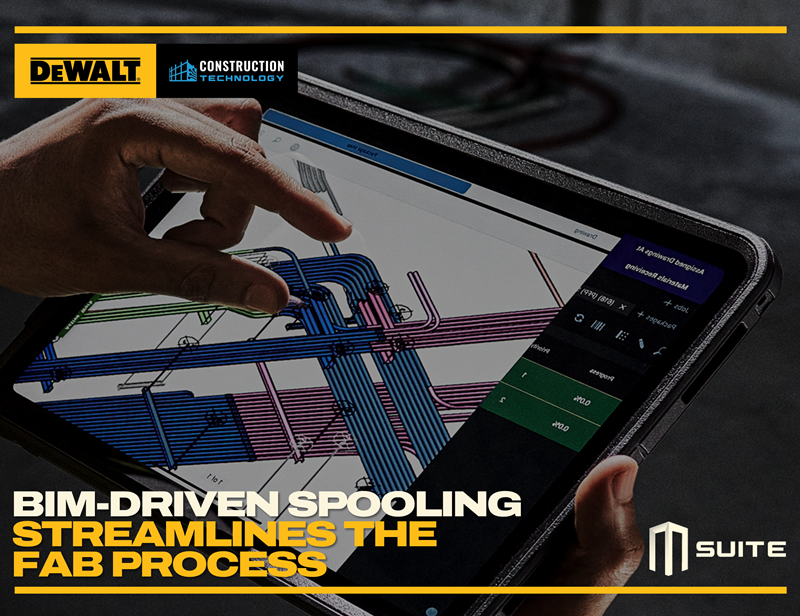
Fabrication teams are under more pressure than at any point in the last two decades. Schedules keep shrinking. Skilled labor remains scarce. Owners demand certainty, not excuses. Yet many fabrication workflows still rely on fragmented handoffs between BIM detailing, spooling, and the shop floor.
BIM-driven spooling fixes that disconnect. When spooling is generated directly from coordinated BIM models, fabrication becomes faster, more predictable, and dramatically less wasteful. Powered by DEWALT Construction Technology and delivered through MSUITE, BIM-driven spooling transforms BIM from a coordination tool into a true production engine.
This article explores why BIM-driven spooling matters now, how it works in practice, and how MSUITE helps fabrication teams protect margins while accelerating delivery.
The Fabrication Problem BIM Was Meant to Solve
BIM adoption across MEP and industrial construction has grown steadily, but most contractors stop short of realizing its full value. Models are coordinated, clashes are resolved, and drawings are issued. Then the process breaks down.
Spooling often happens outside BIM using spreadsheets, manual detailing, or disconnected tools. Fabrication teams reinterpret drawings, recreate data, and make assumptions that were already resolved upstream.
Industry research shows how costly this fragmentation can be. McKinsey estimates that construction productivity has remained flat for decades, largely due to poor data flow and fragmented processes. Source
When BIM does not connect directly to fabrication, rework, delays, and labor waste become inevitable.
What BIM-Driven Spooling Actually Means
BIM-driven spooling is not simply exporting drawings from a model. It is the automated generation of fabrication spools directly from coordinated BIM data, with embedded intelligence that carries through the shop and into the field.
True BIM-driven spooling includes:
- Geometry generated directly from the model
- Embedded metadata for materials, systems, and locations
- Consistent naming, tagging, and revision control
- Alignment with hanger placement and installation sequencing
Instead of treating spooling as a downstream interpretation step, BIM-driven spooling treats it as a continuation of modeling.
Why Traditional Spooling Creates Risk
Traditional spooling workflows introduce risk at exactly the wrong time.
Common failure points include:
- Manual recreation of spool geometry
- Inconsistent naming conventions between BIM and shop drawings
- Late discovery of coordination or clearance issues
- Limited visibility into spool production status
The Financial Management Institute (FMI) estimates that labor inefficiency and rework represent a multi-billion-dollar annual opportunity for improvement across construction. Source:
Disconnected spooling workflows are a major contributor to this waste.
How BIM-Driven Spooling Streamlines Fabrication
BIM-driven spooling directly addresses the bottlenecks that slow fabrication teams.
Faster Spool Creation
Automated spooling eliminates redundant detailing. Once a model is coordinated and approved, spools are generated directly from BIM. That compresses timelines and reduces dependency on scarce detailing labor.
Higher Fabrication Accuracy
Because spools originate from the same coordinated model used for clash detection, errors are resolved before material reaches the shop floor. That protects labor hours and reduces scrap.
Real-Time Production Visibility
Data-rich spools allow fabrication managers to track progress by spool, system, or zone. Instead of relying on status meetings or manual updates, teams see fabrication reality in real time.
Improved Field Coordination
Install crews receive spools that reflect actual site conditions, hanger locations, and sequencing. Fewer surprises translate directly into faster installs and fewer RFIs.
Why BIM-Driven Spooling Is Now a Competitive Requirement
Several industry forces make BIM-driven spooling essential rather than optional.
Labor Constraints
Autodesk research highlights the persistent labor shortage and the need to do more with fewer skilled workers. Source:
Automation and efficiency are no longer nice-to-haves. They are survival tools.
Schedule Compression
Owners, especially in data centers, healthcare, and advanced manufacturing, demand accelerated schedules with certainty. Fabrication delays ripple downstream and quickly erodes trust.
Margin Pressure
Rising material costs and fixed-price contracts leave little room for inefficiency. Every rework cycle eats directly into profit.
BIM-driven spooling addresses all three pressures by reducing manual effort, improving accuracy, and increasing predictability.
How MSUITE Enables BIM-Driven Spooling at Scale
MSUITE was purpose-built to connect BIM, fabrication, and field workflows into a single ecosystem.
Key capabilities include:
Fabrication-First BIM Structure
- MSUITE structures BIM data specifically for fabrication. That structure matters because automation, reporting, and AI depend on consistent, connected information.
Automated Spooling from BIM
- Spools generate directly from the model with standardized logic and metadata. When designs change, updates propagate forward instead of breaking downstream workflows.
Integrated Production Tracking
- Spooling does not stop at creation. MSUITE tracks each spool through fabrication, giving teams live insight into progress, bottlenecks, and risk.
Connected Hanger and Support Workflows
- By integrating hanger and support data into BIM-driven spooling, MSUITE ensures spools reflect real installation conditions, not assumptions made in isolation.
BIM-Driven Spooling as the Foundation for AI and Automation
The industry is moving rapidly toward AI-driven insights, predictive scheduling, and automated production planning. None of that works without structured data.
BIM-driven spooling creates that foundation by ensuring fabrication data is:
- Consistent
- Connected
- Machine-readable
MSUITE structures data from BIM through fabrication so contractors can effectively leverage AI for predictive insights and decision-making. Without that structure, AI remains theoretical.
BIM-Driven Spooling vs Coordination-Only BIM
Many contractors believe they are “doing BIM” but still struggle in fabrication.
| Coordination-Only BIM | BIM-Driven Spooling |
| Static drawings | Data-rich spools |
| Manual shop interpretation | Automated spool generation |
| Late error discovery | Early issue resolution |
| Limited production visibility | Real-time fabrication insight |
Only BIM-driven spooling scales with modern project demands.
The DEWALT Standard Applied to Digital Fabrication
DEWALT has built its reputation on durability, precision, and performance on the jobsite. That same standard now applies to digital construction workflows.
Through MSUITE, DEWALT Construction Technology brings structure, automation, and confidence to BIM-driven spooling. Fabrication teams gain tools that match the speed and complexity of today’s projects without adding operational chaos.
Final Takeaway
BIM-driven spooling transforms fabrication from a reactive process into a controlled, predictable production workflow. It reduces rework, accelerates schedules, and protects margins at a time when contractors can afford none of those losses.
MSUITE enables BIM-driven spooling at scale by connecting BIM, fabrication, and field operations through structured, actionable data. For contractors serious about productivity, predictability, and growth, BIM-driven spooling is no longer the future. It is the standard.