

If you are managing mechanical, electrical, and plumbing work across active construction projects, you already know the coordination problem. Drawings change. Schedules shift. Field teams wait on spool deliveries stuck in a queue because nobody updated the tracking spreadsheet. MEP software addresses exactly that problem, and in 2026, contractor adoption has crossed a threshold where it is less a competitive edge and more a baseline operational requirement.
This article covers what MEP software actually does, how it fits into the broader world of MEP construction, the data behind the industry’s move toward prefabrication, and what to look for when evaluating platforms.
What Does MEP Mean in Construction?
MEP stands for mechanical, electrical, and plumbing. These are the three major building systems that keep any structure functional. In construction, MEP work covers HVAC ductwork and piping systems, electrical distribution, fire protection, and plumbing infrastructure.
MEP construction is among the most coordination-intensive work on any job site. Unlike structural or architectural trades, MEP systems are deeply interdependent: a duct run may conflict with a pipe chase; a pipe chase may conflict with electrical conduit. When these systems are designed, fabricated, and installed without a shared digital thread, rework is nearly unavoidable.
The scale of this market reflects how central MEP work is to construction overall. According to Mordor Intelligence, the U.S. MEP services market is projected to grow from $32.55 billion in 2025 to $47.05 billion by 2031 at a CAGR of 6.33%. The global MEP software market specifically crossed $3.5 billion in 2024 and is forecast to grow at a 9.6% CAGR through 2034, according to Grand View Research, driven primarily by rising BIM adoption and contractor demand for production visibility.
Sources: Mordor Intelligence, United States MEP Services Market (2026); Grand View Research / GM Insights, MEP Software Market Size & Share (2025)
The Prefabrication Shift and Why It Changes the Software Requirement
The most significant structural change in MEP construction right now is the accelerating move to prefabrication. Contractors are moving assembly work off chaotic job sites and into controlled shop environments, where quality, productivity, and schedule can be managed more reliably.
The data from FMI’s Labor Productivity Study is clear on the direction of travel. Contractors surveyed reported that roughly 16 to 18 percent of total craft labor hours were being spent on prefabricated assemblies at the time of the study. Those same contractors expected that share to double, reaching 34 percent of labor hours within five years. For MEP contractors specifically, who made up nearly 60 percent of the study’s respondents, the same 34 percent target was cited.
Source: FMI Corp., Labor Productivity Study Part 2: Prefabrication — fmicorp.com
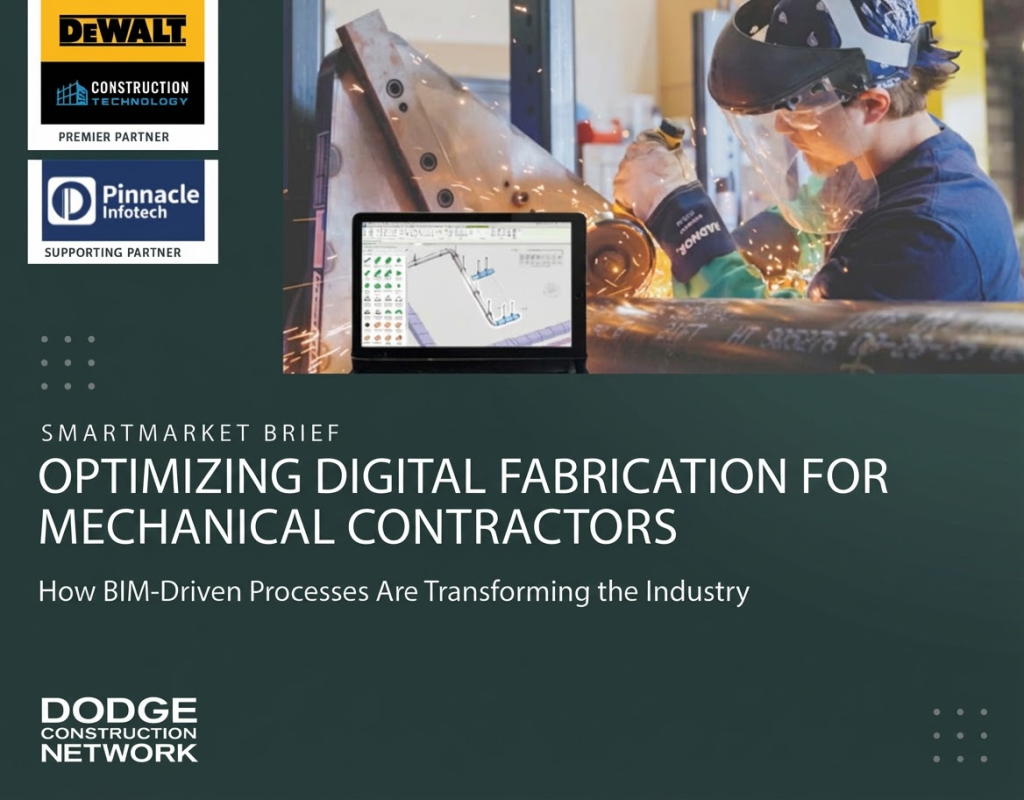
The shift is no longer theoretical. According to the latest SmartMarket Brief from Dodge Construction Network and DEWALT Construction Technology, 82% of mechanical contractors now say fabrication is required to win work, not just improve it. That marks a clear transition from competitive advantage to baseline expectation.
The drivers are the same pressures contractors have been facing for years, only more acute. Labor constraints, schedule compression, and rising project complexity are forcing firms to find more predictable, scalable ways to deliver. Fabrication solves for all three. By moving work into a controlled shop environment, contractors increase output per labor hour, standardize production, and reduce variability that leads to rework and delays.
What has changed is how consistently the industry is seeing results. The SmartMarket data reinforces what leading contractors already know: firms that invest in fabrication are not just improving operations, they are winning more projects. Owners and general contractors are prioritizing partners who can deliver certainty, and fabrication-backed workflows provide that confidence.
Just as important, the report underscores a second critical point: fabrication at scale depends on digital connectivity. Contractors that tightly integrate BIM with shop production workflows are far more likely to achieve schedule reliability, cost control, and higher throughput. Those still operating with disconnected systems struggle to capture the full value.
That is where modern MEP software becomes essential. It is not just about enabling fabrication. It is about connecting BIM, shop production, and field installation into a single, data-driven workflow that allows contractors to operate with speed, precision, and predictability.
Source: Optimizing Digital Fabrication for Mechanical Contractors: How BIM-Driven Processes Are Transforming the Industry, published by Dodge Construction Network
What the SmartMarket Brief also showed is that BIM adoption is what unlocks prefabrication benefits at scale. Shops that cannot connect their BIM environment directly to fabrication production do not capture the same gains. That connection is exactly what MEP software is designed to provide.
Optimizing Digital Fabrication for Mechanical Contractors: How BIM-Driven Processes Are Transforming the Industry provides deeper analysis of:
- Fabrication maturity levels
- BIM usage trends
- AI adoption patterns
- Multi-trade fabrication benchmarks
- Integration challenges
- Workforce needs
Digital fabrication is no longer an innovation strategy. It is a performance standard. Download the full report here: [GET REPORT]
What MEP Software Actually Does
MEP software is a broad category. At the lower end it might mean a spreadsheet template or a basic project tracker. At the higher end, where platforms like MSUITE operate, it means a purpose-built system that connects your design environment, fabrication shop, and field teams in a single platform.
Design-to-Fabrication Automation (BIM)
For BIM and VDC teams, MEP software automates the handoff from design to fabrication. This means version-controlled drawings, automated spool creation, cut lists, joint lists, and bill of materials generated without manual re-entry. MSUITE BIM improves spooling productivity up to 10x compared to manual workflows in Revit or Fabrication CADmep by eliminating the repetitive, error-prone work of dimensioning and tagging that consumes hours of detailer time on every project.
The practical impact for fabrication managers is that drawing revisions no longer require someone to manually update a spreadsheet, reprint drawings, and walk them to the shop floor. Version control happens automatically, and the shop floor always has the current set.
Real-Time Shop Floor Tracking (MSUITE FAB)
For fabrication managers and operations leads, MEP software provides live visibility into what is being built, by whom, and where it is in the process. Work instructions flow in from BIM or CAD. Status updates flow back in real time. Timesheets, weld logs, earned value, and material logistics are tracked passively without manual entry.
This matters most when your field team is asking where their spools are. With real-time fabrication tracking, that question has an immediate answer backed by actual production data rather than someone’s best recollection of what was happening on the floor yesterday.
It also matters for project managers and owners who need to know whether a job is on schedule. Rather than waiting for a weekly status meeting, current production data is accessible at any time in the system.
Weld Logs, QA/QC, and Compliance Documentation
For EPC and oil and gas fabricators, automated weld log generation is one of the highest-value capabilities in MEP software. Each weld must be associated with a qualified welder ID, the pipe serial number and heat number, inspection results, and NDE (non-destructive evaluation) scheduling. These are contractual requirements from project owners including Shell, Texaco, and other major operators.
When weld logs are maintained manually, the administrative burden is significant. Assembling complete NDE documentation, joint travelers, and QA packages from paper records consumes days of staff time per project. Automated weld log generation eliminates that work entirely by capturing the required information at the point of production.
Handover and Reporting
Project handover, the documentation package delivered to the owner or GC at project completion, is one of the most time-consuming tasks in MEP construction when managed without software. MEP software maintains a running digital record throughout fabrication: weld logs, QA/QC checkpoints, inspection records, and as-built data compile automatically as work progresses. At handover, the package is already assembled rather than requiring days of manual effort to pull together.
Custom reporting on all fabrication activities, a requirement from most oil and gas project owners, is generated on demand rather than through manual extraction from disconnected systems.
Why Spreadsheets and Legacy ERPs Fall Short
Most MEP contractors start with spreadsheets for tracking fabrication. They are familiar, free, and flexible, which makes them a reasonable starting point. The problems that emerge at scale are consistent across the industry:
- Data lives in multiple disconnected files with no single source of truth
- Status updates require someone to manually collect and enter information from the shop floor, typically daily or weekly
- Version control on drawings is informal, leading to fabrication errors and rework when a drawing revision does not reach the shop floor in time
- Reporting for client handover requires assembling information across disconnected systems, a process that takes days
- Field teams have no real-time visibility into fabrication progress, so they rely on phone calls and emails to get answers that a software system should provide automatically
- Excel spreadsheets cannot support multiple concurrent users without version conflicts, which creates bottlenecks on active projects
Legacy ERP systems are built for manufacturing and handle procurement and financial tracking reasonably well. What they do not handle is the specific language of MEP fabrication: spool status, weld tracking, BIM integration, or NDE documentation. MEP software fills that gap without replacing the ERP. The two systems complement each other.
FMI’s research identifies poor planning, communication, and collaboration as three of the top four internal factors negatively affecting field labor productivity. Those are precisely the problems that MEP software is designed to address by replacing manual coordination with structured, shared data.
Key Questions to Ask When Evaluating MEP Software
Not all MEP software is built the same way. When evaluating platforms, these questions help distinguish systems that are genuinely purpose-built for MEP fabrication from those adapted from adjacent industries:
Does it integrate with your BIM environment? Platforms that connect to Revit, Fabrication CADmep, or Isogen eliminate re-entry and version drift between design and fabrication. If the connection is not native, drawing revisions will still require manual intervention.
Does it track labor and productivity passively? Manual time entry is a bottleneck and a source of inaccurate data. Systems that capture productivity information as work happens give managers accurate earned value data without relying on self-reporting.
Does it handle weld logs and QA/QC automatically? For oil and gas and industrial fabricators, automated weld logs and NDE tracking are compliance requirements. A system that generates these records at the point of production removes both the manual burden and the risk of documentation errors.
Can it generate client-ready handover packages automatically? If your team is still manually assembling turnover documents at project completion, that represents hours of labor per project that software should be handling. Ask vendors specifically how handover documentation is generated.
Does it support real-time field visibility? Field supervisors should be able to see where their spools are in the fabrication queue without calling the shop. If status information requires a phone call or a manual lookup, that gap will cost time on every active project.
Was it built for fabrication, or adapted from something else? Systems built inside fabrication shops reflect how fabrication actually works. Systems adapted from manufacturing ERP or general project management tools often require workarounds for fabrication-specific workflows.
What MEP Companies Are Seeing in Practice
The most concrete signal that MEP software delivers results is the outcomes that MEP companies report after implementation. Shapiro and Duncan, a mechanical contractor serving the Washington D.C. metro area, saves $1.4 million per year using MSUITE across their fabrication operations. McKinstry, Limbach, and Peterson Sheet Metal have all integrated MSUITE to reduce cost and increase throughput across design and fabrication workflows.
The consistent pattern in customer results is not that companies do something fundamentally different after implementing software. The savings come from eliminating the manual work that was consuming time at every stage: data entry, status chasing, drawing revision management, and handover assembly. When those hours are recovered, the same team produces more output with fewer errors.
One MEP contractor quoted in FMI’s prefabrication research described a casino and hotel project where prefabrication, supported by structured production tracking, required 25 percent less field labor and cut nearly two months off the installation timeline. That kind of result depends on having accurate data flowing between design, the shop floor, and the field. Without the software infrastructure, the coordination work alone consumes the gains that prefabrication is supposed to deliver.
MEP Software and the Labor Shortage
The construction industry’s skilled labor shortage is not a short-term condition. It is structural, driven by demographics, training pipelines that have not kept pace with retirements, and sustained demand growth across commercial, industrial, and infrastructure sectors. According to FMI, nearly two-thirds of contractors surveyed identified a lack of qualified craft labor as a top factor negatively affecting their productivity.
MEP software addresses this constraint in two ways. First, it allows existing staff to handle more volume by eliminating the administrative overhead that currently consumes a significant portion of their time. A fabrication manager who spends two hours per day manually updating spreadsheets and tracking down status information can redirect those hours to higher-value work. Second, it enables less experienced workers to perform standardized, repeatable tasks accurately because the work instructions, sequencing, and documentation requirements are built into the system rather than carried in someone’s head.
Both of those benefits are particularly valuable for shops that are growing. Adding fabrication volume without adding proportional headcount is only possible if the operational infrastructure can scale. Manual processes do not scale. Software does.
MEP Software and the Future of Prefabrication
Prefabrication is the structural trend reshaping MEP construction. As more mechanical contractors move work into controlled fabrication environments, the need for software that bridges design, shop, and field becomes acute. The contractors winning new work in 2026 are the ones who can demonstrate reliable delivery schedules, accurate material tracking, and clean project documentation.
FMI’s research projects that contractors will double their prefabrication labor hours from roughly 16 to 18 percent today to 34 percent within five years. That is not a gradual trend. It is a fundamental shift in how MEP work gets done, and it requires the digital infrastructure to match. Shops that are still running on spreadsheets and paper weld logs will face significant capacity constraints as prefabrication volume grows.
Approximately 35 percent of projects currently incorporate prefabricated MEP components, according to Business Research Insights, and that share is expected to grow substantially as project owners increasingly specify prefabrication-driven delivery in their procurement requirements. According to Dodge Construction Network, contractors who cannot demonstrate fabrication-driven delivery are increasingly at a disadvantage during bid and prequalification.
Source: Business Research Insights, MEP Services Market Report (2024); Dodge Construction Network, cited in MSUITE (2026)
Ready to See How MSUITE Connects Your MEP Workflow?
MSUITE is productivity software built inside a fabrication shop, designed specifically for MEP and EPC contractors. From BIM detailing to real-time shop floor tracking to automated handover documentation, MSUITE connects every stage of your project lifecycle in one platform.
The same platform handles weld logs, joint travelers, QA/QC routing, NDE scheduling, and turnover package generation automatically, so your team is not spending project budget on administrative work that software should handle.
Schedule a demo to see how MSUITE works for your fabrication operation.
Sources
FMI Corp., 2024 Labor Productivity Study Part 2: Prefabrication (May 2024)
Dodge Data & Analytics, Prefabrication and Modular Construction 2020 SmartMarket Report
MSUITE, Dodge Report Reveals Key MEP Process Improvements for Contractors
Mordor Intelligence, United States MEP Services Market (2026)
GM Insights / Grand View Research, MEP Software Market Size & Share, Forecast 2034
EC&M, FMI Study Explores Construction Prefabrication (July 2024)
MSUITE, Why MEP Fabricators Are Doubling Down on Prefabrication Technology in 2026