
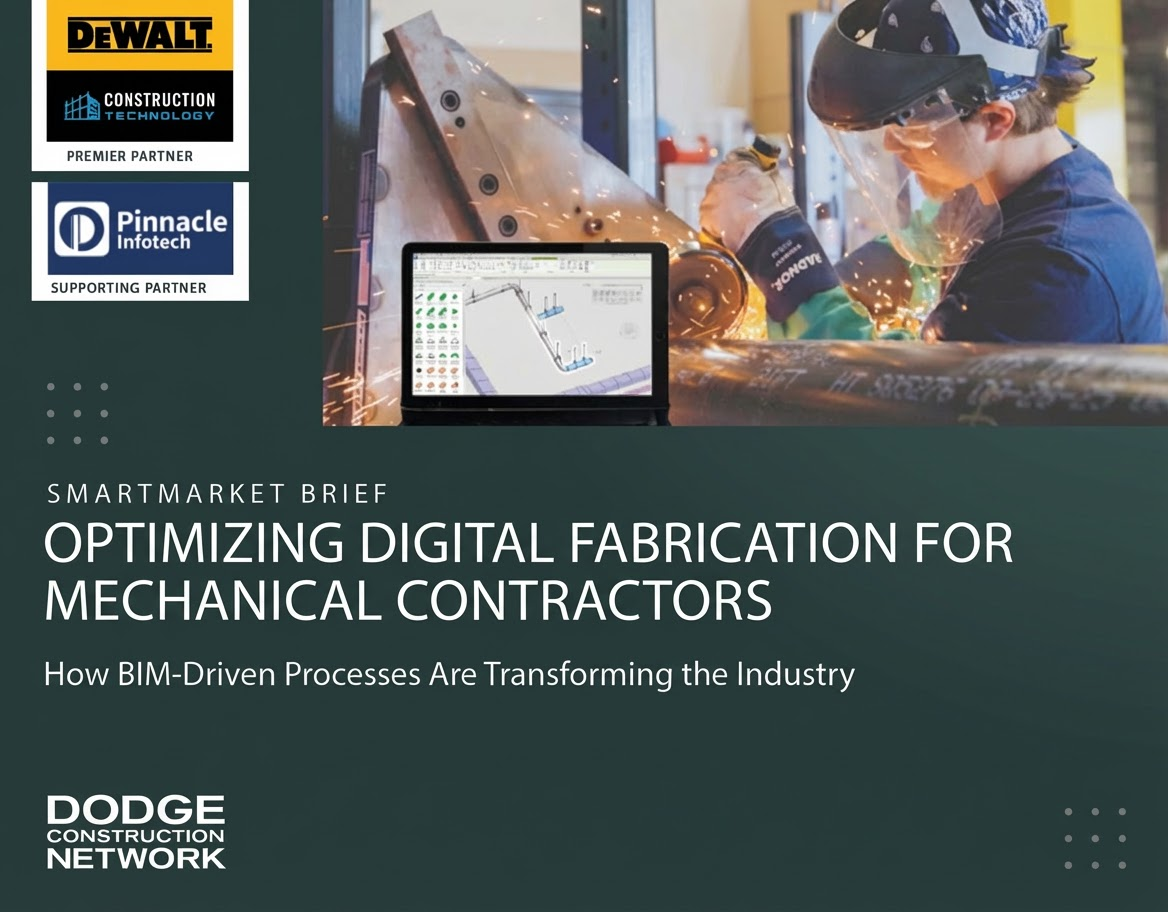
What the New Dodge Construction Network Study Means for MEP Leaders in 2026
Digital fabrication has crossed a critical threshold.
According to newly released research from Dodge Construction Network, in partnership with DEWALT Construction Technology and supported by Pinnacle Infotech, 82% of mechanical contractors report that fabrication capability is now a prerequisite for winning projects. What was once a competitive advantage is now a baseline expectation.
Owners and general contractors increasingly require fabrication-ready workflows. Mechanical contractors that cannot execute digitally are no longer viewed as progressive — they are viewed as behind.
This research signals a structural shift in how mechanical construction is evaluated, planned, and delivered.
Fabrication Has Become Embedded in Contractor Selection
The study’s headline finding is clear:
82% of mechanical contractors say fabrication capability is required to win work.
That level of consensus marks a turning point. Fabrication is no longer a back-end shop function. It is a selection criterion tied directly to:
- Schedule certainty
- Cost performance
- Risk mitigation
- Quality control
- Competitive positioning
As Ian Harney, Vice President of DEWALT Construction Technology, explains:
“BIM and fabrication management software have become indispensable for driving efficiency, safety, and sustainability.”
Fabrication has moved from operational capability to strategic control point.
BIM Is Nearly Universal — But Maturity Varies
The research confirms that BIM adoption is high across the mechanical sector:
- 87% of mechanical contractors use BIM
- 100% of contractors with annual revenue above $100 million use BIM
- 33% of small contractors still do not use BIM
- Over 40% of mid-sized contractors use BIM on less than half of their projects
Importantly, over 90% of mechanical contractors who use BIM also use it for fabrication workflows.
The tools are widely adopted.
But depth and consistency of execution still vary.
The gap is no longer about whether contractors use BIM. It is about how well BIM connects to fabrication management, process tracking, and downstream execution.
Artificial Intelligence Is Gaining Ground
AI adoption is no longer theoretical.
The study reports that 53% of mechanical contractors currently use artificial intelligence, largely for:
- Design optimization
- Estimating
- Analysis
- Error reduction
Nearly half of respondents say they are adopting AI to drive smarter, more productive construction workflows.
The implication is significant: AI is beginning to influence modeling, planning, and fabrication decisions. But its impact depends entirely on structured, connected data.
Disconnected spreadsheets and siloed workflows limit AI’s value. Integrated digital fabrication environments unlock it.
Digital Fabrication Delivers Measurable Business Benefits
Mechanical contractors report tangible improvements from digital fabrication investment.
The most frequently cited benefits include:
- Improved cost performance
- Reduced errors
- Increased labor productivity
- Higher profitability
- Improved quality
- Reduced waste
- Better collaboration
- Improved safety
- Increased ability to win work
These gains reinforce why fabrication capability is now required for project awards.
When modeling, fabrication, and process management are aligned, contractors gain predictability. Predictability protects margins.
Integration Remains the Biggest Operational Gap
Despite strong adoption of both BIM and digital fabrication tools, integration remains uneven.
The study found:
- 86% of firms have created integrations between BIM and digital fabrication systems
- Only 50% say those integrations work well
That gap represents the industry’s largest opportunity for improvement.
When BIM and fabrication systems are not fully connected:
- Forecasting becomes unreliable
- Process tracking breaks down
- Shop productivity becomes difficult to measure
- Field coordination suffers
Contractors also report needing more BIM and fabrication staff as digital investments increase.
The challenge is not tool adoption.
It is workflow connection.
Multi-Trade Fabrication Is Expanding — With Significant Time Savings
Multi-trade fabrication continues to grow across the industry:
- 77% of contractors perform some level of multi-trade fabrication
- 73% of small contractors participate
Small assemblies are common, fabricated by 78% of contractors.
More complex assemblies remain underutilized:
- Skids: 49%
- Racks: 53%
However, the payoff is clear:
- 76% of contractors performing multi-trade fabrication report significant time savings
- Nearly one in five report time savings of 20% or more
As Steve Jones, Senior Director of Industry Insights at Dodge Construction Network, notes:
“By connecting BIM and fabrication with process management systems, they gain earlier visibility into cost, constructability, and risk.”
Earlier visibility changes outcomes long before material reaches the shop.
Five Strategic Takeaways for Mechanical Leaders
The research confirms five realities shaping 2026:
- Fabrication capability is now mandatory to compete.
- BIM is nearly universal, but execution maturity varies.
- AI adoption is accelerating.
- Integration gaps are the largest operational risk.
- Multi-trade fabrication yields measurable time savings.
The firms pulling ahead are not simply buying software.
They are structuring workflows that connect:
- BIM modeling
- Fabrication planning
- Shop execution
- Process tracking
- Field installation
When information flows continuously across those stages, contractors gain certainty. Certainty protects margins.
 Download the Full SmartMarket Brief
 Download the Full SmartMarket Brief
The complete report,
“Optimizing Digital Fabrication for Mechanical Contractors: How BIM-Driven Processes Are Transforming the Industry,” provides deeper analysis of:
- Fabrication maturity levels
- BIM usage trends
- AI adoption patterns
- Multi-trade fabrication benchmarks
- Integration challenges
- Workforce needs
Digital fabrication is no longer an innovation strategy.
It is a performance standard. Download the full report here: [GET REPORT]
Mechanical contractors that connect modeling, fabrication, and process management today will define execution expectations tomorrow.