
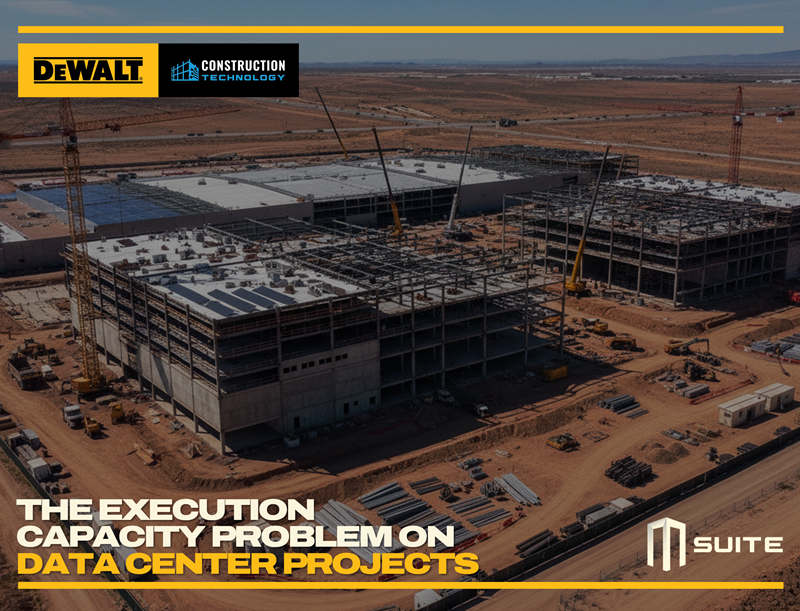
Data center construction is not slowing down. Demand continues to surge as artificial intelligence, cloud expansion, redundancy planning, and edge computing drive long-term investment. Yet despite capital availability and aggressive project pipelines, many data center projects struggle to maintain schedule certainty.
The issue is often described as a labor shortage. While labor constraints are real, they are not the root cause. In 2026, the defining limitation in data center construction is execution capacity.
Execution capacity determines how much work a contractor can reliably deliver per labor hour. In highly repetitive, schedule-critical environments like data centers, execution capacity matters more than raw headcount.
Key Takeaways
- Why are labor shortages impacting data center construction?
Labor shortages expose execution inefficiencies across BIM, fabrication, and field workflows. Data centers require repeatable, high-precision MEP installation that traditional jobsite coordination cannot scale. - How do contractors overcome labor constraints in data centers?
By increasing execution capacity through connected BIM-to-fabrication workflows, standardized assemblies, and production-driven delivery models. - What matters more than labor availability in 2026?
Execution discipline, workflow continuity, and the ability to deliver predictable output per labor hour.
What Is the Biggest Constraint in Data Center Construction Today?
The biggest constraint in data center construction is execution capacity, not demand, capital, or land availability.
Hyperscale and colocation owners continue to fund new campuses, but contractors face limits in how efficiently specialized labor can deliver complex MEP systems at scale. Labor shortages amplify the issue, but fragmentation across BIM, fabrication, and field execution is what turns scarcity into schedule risk.
Why Labor Shortages Hit Data Center Projects Harder Than Other Builds
Data centers magnify labor inefficiencies in ways that commercial or residential projects do not.
Key reasons include:
- MEP scope dominates both cost and schedule
- Electrical, mechanical, and controls work requires specialized certification
- Installation sequences repeat across identical halls and phases
- Errors surface late during commissioning, when recovery options are limited
Unlike other project types, data centers offer little tolerance for improvisation. When execution breaks down, delays compound rapidly.
According to Deloitte’s engineering and construction outlook, mission-critical facilities now compete directly with semiconductor manufacturing, energy infrastructure, and advanced industrial projects for the same skilled trades.
Labor Shortages Are Structural, Not Temporary
The construction workforce challenge is no longer cyclical.
The Associated Builders and Contractors reports that even as overall construction demand cools, labor availability remains constrained, particularly for specialty trades. Data center projects remain insulated from demand softening, which intensifies competition for skilled labor.
This creates a long-term reality:
- Skilled labor cannot be added quickly
- Training and certification timelines are long
- Labor productivity must increase to meet schedules
Adding workers is no longer the primary lever for growth. It’s empowering workers to be more efficient, reducing the manual steps that push talent out of the market, and enabling them to focus on what they joined the trades for: building the world around us.
How Labor Shortages Are Changing Data Center Construction Execution
Labor shortages are forcing a shift in responsibility upstream.
Instead of absorbing variability in the field, leading data center teams now:
- Reduce uncertainty before work reaches installation crews
- Push coordination into BIM and fabrication workflows
- Standardize assemblies and installation sequences
- Treat construction as a production system rather than a series of custom tasks
This shift increases output without increasing labor hours.
What “Execution Capacity” Means in Data Center Construction
Execution capacity is the ability to deliver predictable work output per labor hour.
In data center projects, execution capacity improves when:
- BIM models are fabrication-ready earlier
- Spools and assemblies follow consistent standards
- Production status is visible across teams
- Field crews receive complete, build-ready inputs
Higher execution capacity allows contractors to scale workloads without scaling headcount.
McKinsey highlights that construction productivity lags other industries because work is still managed as bespoke, project-by-project activity instead of repeatable production.
Data centers expose this gap more clearly than any other project type.
Why Prefabrication Alone Does Not Solve the Labor Problem
Prefabrication is now common in data center construction. However, prefabrication by itself does not guarantee productivity gains.
Without connected workflows:
- Model changes fail to reach fabrication consistently
- Shops produce volume without schedule alignment
- Field crews absorb missing information
- Rework migrates downstream instead of disappearing
Prefabrication only improves labor productivity when it operates as a data-driven production system, not just an offsite activity. Without implementing a connected system, the same headaches will inevitably take place.
Why Connected BIM-to-Fabrication Workflows Matter More in Data Centers
Connected BIM-to-fabrication workflows reduce labor waste by removing manual coordination.
They ensure:
- One source of truth for models, spools, and assemblies
- Automatic propagation of design changes
- Consistent outputs across repetitive spaces
- Predictable installation sequencing
This minimizes reliance on word-of-mouth knowledge and protects scarce skilled labor from coordination work that adds no installation value.
The Autodesk Construction Industry Report shows that firms using connected digital workflows experience fewer schedule disruptions and stronger cost control.
How Execution Discipline Reduces Commissioning Risk
Commissioning is where data center projects either validate execution discipline or expose its absence.
Disconnected workflows often hide small deviations until late stages. By then, options are limited and expensive.
Connected execution models:
- Surface production issues earlier
- Align fabrication output with installation readiness
- Reduce late-stage field modifications
- Improve predictability during integrated systems testing
Execution capacity protects commissioning schedules as much as it protects installation productivity.
What Owners and Developers Are Prioritizing in 2026
Owners are no longer asking contractors only if they can staff projects.
They are asking:
- How repeatable is your delivery model?
- How do you control fabrication and installation risk?
- How do you maintain schedule certainty when labor tightens?
Labor availability matters, but execution discipline matters more.
MSUITE Helps Contractor’s Scale
As data center projects scale, many teams are adopting platforms designed to structure and connect fabrication information across BIM, the shop, and the field.
MSUITE supports this approach by focusing on workflow continuity rather than point solutions. Its role is to help teams maintain alignment between models, fabrication outputs, and installation readiness as production volume increases.
In practice, this supports execution capacity by:
- Keeping fabrication data connected to the model
- Providing visibility into production status
- Standardizing outputs across repetitive scopes
- Enabling feedback between fabrication and field teams
This reduces variability without adding labor. See how MSUITE can help you increase capacity.